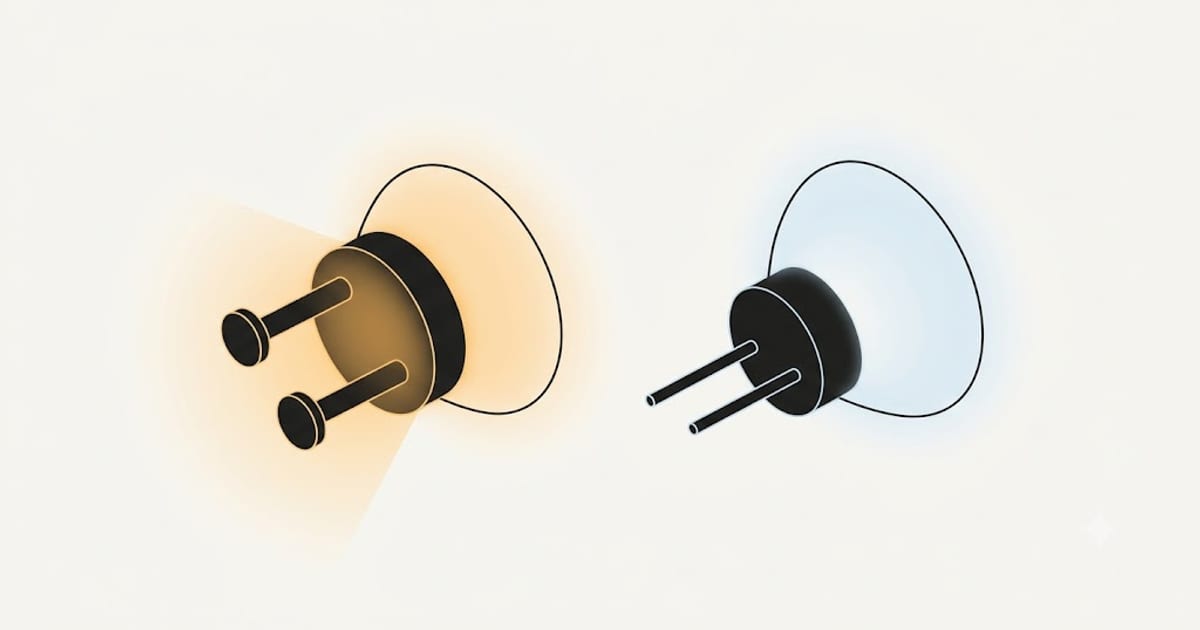
From below, in a ceiling, they are almost the same object: a small reflector lamp about 50 mm across sitting in a downlight housing. From behind, they are two different electrical systems.
GU10 is mains voltage. MR16 is 12 volts and needs a transformer. Fitting the wrong one either does nothing or destroys the lamp instantly.
Telling them apart
The base is the only reliable difference, and it takes one look.
GU10 has two thick pins with wider flattened discs on the ends, set fairly far apart. It goes into the holder and twists a quarter turn to lock. The name says so: G for pins, U for the twist-lock, 10 for the 10 mm spacing.
MR16 — properly GU5.3 as a base — has two thin straight pins of even diameter, closer together. It pushes straight in with no twist.
If the lamp twists to lock, it is GU10 and it is running on mains. If it pulls straight out, it is MR16 and there is a transformer somewhere above the ceiling.
| GU10 | MR16 / GU5.3 | |
|---|---|---|
| Voltage | 240 V or 120 V mains | 12 V |
| Pins | Thick, with disc ends, 10 mm apart | Thin, even, 5.3 mm apart |
| Fitting | Twist to lock | Push fit |
| Transformer | None | Required |
| Wiring at the fitting | Mains | Low voltage |
| Typical use | Modern domestic downlights | Older installations, display, some outdoor |
Why MR16 existed, and why it mostly stopped
MR16 came from the halogen era, and at the time the 12 V version had a real advantage: a low-voltage halogen filament is shorter and thicker than a mains one, which means it can sit closer to the centre of the reflector and produce a tighter, better-controlled beam. For display lighting and retail, that mattered.
The cost was a transformer for every fitting or every group of fittings, plus the losses in it.
LEDs removed the advantage. An LED does not have a filament to focus, so the optical argument disappeared, and a mains-voltage LED lamp with its driver in the base is simpler than an LED lamp plus an external transformer. GU10 is now the domestic default, and MR16 survives mainly in installations that already had it and in some outdoor and display applications where low voltage is wanted for other reasons.
Retrofitting MR16 to LED: the transformer is the problem
This is where most of the trouble is, and it catches people who have done everything else right.
An existing MR16 installation has a transformer sized for halogen. Two kinds exist and they fail with LEDs in different ways.
Electronic transformers — the common modern type — have a minimum load, often 20 W or more. Three 5 W LED lamps total 15 W, which is below it. The transformer cannot regulate, and the symptom is flicker, buzzing, or lamps that will not start at all.
Wirewound or toroidal transformers — the older heavy type — generally tolerate low loads better, and are more likely to work with an LED retrofit unchanged. They are also the type that genuinely wants leading-edge dimming if a dimmer is involved.
Three ways out of it:
Replace the transformer with an LED driver rated from a low minimum. The correct fix if the fittings are staying.
Convert the fittings to GU10. Remove the transformer, run mains to the fitting, change the lamp holder. This is the usual answer when a whole ceiling is being redone, and it removes a component that can fail.
Add load. Works, and it means burning watts as heat to keep a transformer happy, which undoes the point of the change.
The safety point worth being clear about
The two are not interchangeable and the failure is not gentle.
An MR16 lamp fitted to a mains supply — via an adapter, or into a fitting someone has converted — sees twenty times its design voltage and fails immediately, sometimes violently.
A GU10 lamp on a 12 V supply does nothing at all, which is the harmless direction.
Adapters between the two bases exist and are sold cheaply. A mechanical adapter does not change the voltage. An adapter that lets a GU10 lamp sit in an MR16 holder still delivers 12 V to a lamp expecting mains, and it will not light. There is no adapter that makes the swap work; the wiring behind the fitting decides which lamp belongs there.
If you are unsure what is behind the ceiling, that is a question for an electrician rather than a shop assistant.
Choosing a GU10 lamp once you know that is what you have
The base settles the electrical question. Four specifications settle whether the lamp is good.
Lumens, not watts. A 50 W halogen GU10 produced around 350–400 lumens. Most LED replacements are 350–500. Use the watt to lumen calculator to convert what you remember into what you now buy.
Beam angle. Halogen GU10 was typically 36–38°. LED versions range from 25° to 120°, and swapping a 36° halogen for a 120° LED changes the whole character of a ceiling — the pools merge and the spacing that used to work now over-lights the middle of the room.
CRI 90+ and R9 above 50 for any room where you look at food, faces or fabric.
Dimmable, if there is a dimmer — and check the minimum dimming level, not just the word "dimmable".
MR16 lamps need the same four, plus one more: the driver has to suit the lamp, which brings the transformer question back around.