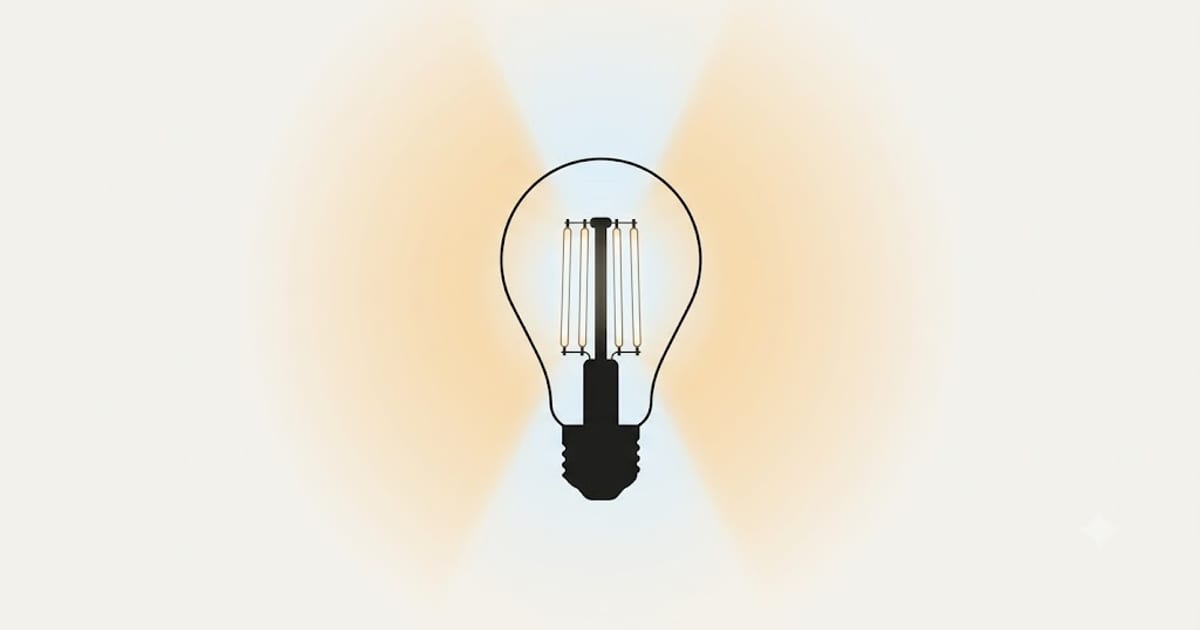
Filament-style LEDs — the ones with slender glowing strips inside clear glass — are the only LED shape that genuinely looks like the bulb it replaced. They also have a specific technical advantage and a specific technical problem, and both are worth knowing before buying a set.
The real advantage: they are actually omnidirectional
Most LED bulbs put their chips on a flat board pointing one way. Even inside a bulb-shaped envelope, a large share of the output goes forward rather than in every direction.
Filament LEDs arrange several slender strips in a ring around a central stem, each emitting from both faces. The result is genuinely close to a sphere of light, which is what an incandescent filament produced.
That matters in exactly the fittings where ordinary LEDs disappoint:
- Table and floor lamps with fabric shades, where a large part of what you see is light going up through the open top and sideways through the shade
- Bare pendants and open fittings, where the bulb is visible and the whole room is lit indirectly
- Chandeliers and multi-arm fittings, where light has to reach outward as well as down
In a shaded lamp, swapping a directional LED for a filament one often restores the room without changing a single lumen — the reasons are set out in same lumens, less light.
The second advantage is appearance. In any fitting where the bulb is visible, a filament LED reads as a light source rather than as a white plastic dome, and the decorative shapes — globe, tube, teardrop — exist for the same reason.
The problem: many are driverless
This is the part that is not on the box.
A conventional LED bulb contains a driver — electronics that convert mains into smooth constant current. Good drivers cost money and take space, which is why LED bulbs have a chunky base.
A filament bulb has almost no base to hide electronics in, and that is the whole aesthetic. So a large share of them are driverless AC LED: the strips are connected more or less directly across rectified mains with minimal smoothing.
The consequence is that output falls to zero twice per mains cycle. Modulation depth is at or near 100%, at 100 or 120 Hz.
You cannot see it directly. Your visual system still processes it, and deep modulation at that frequency is associated with eye strain and headaches over long exposure, and produces a visible stroboscopic effect on anything moving.
Test before buying a set of six. Point a phone camera at the lit bulb and look at the screen, ideally in slow-motion video with HDR turned off. Strong rolling bands mean deep modulation. A driverless filament bulb shows it unmistakably. The full method is in flicker-free LED bulbs.
Dimming is the second casualty
The same construction explains why so many filament LEDs dim badly.
With no driver to interpret a chopped waveform, a driverless lamp responds to phase-cut dimming crudely: it may dim over only part of the range, cut out abruptly near the bottom, buzz audibly, or flicker at low settings.
Two rules follow.
Buy explicitly dimmable filament lamps, and prefer ones that state a minimum dimming level. A lamp that reaches 5% is a different product from one that stops at 30%.
Use a trailing-edge LED-rated dimmer, and watch the minimum load — filament LEDs are typically 4–8 W, so three of them may fall under an older dimmer's threshold. Both issues are covered in minimum load for an LED dimmer.
Where they are the right choice
Any fitting where the bulb is visible and you want it to look like a bulb.
Shaded table lamps and open pendants, for the distribution reason above.
Warm, low-output decorative use — 2200–2700 K, in a fitting that is part of the room's character rather than its light source.
Where they are not
Enclosed fittings. Filament bulbs run their strips hot and most are not rated for sealed shades. Heat is what kills LEDs, and an unrated lamp in an enclosed globe fails early and voids its warranty.
Anywhere you sit for hours — a desk, a reading position, a home office — unless the specific lamp has passed the camera test. Flicker exposure is cumulative and this is the category most likely to fail it.
High-output general lighting. Filament construction does not scale well; most are 400–800 lumens, and the very bright ones run hot enough to shorten their own life.
Damp locations, unless specifically rated.
Buying well
Five checks, in order:
- Camera test for flicker, at full output and dimmed
- Dimmable, with a stated minimum level, if there is a dimmer
- Lumens, not "equivalent" — filament lamps often deliver 400–600 where you assumed 800
- 2200–2700 K for decorative use, 2700 K for anything doing real work
- Enclosed-fixture rating, if the fitting is enclosed
The three-hour version of the same advice: buy one, live with it for a week in the fitting it is meant for, then buy the other five. Filament LEDs vary more between brands than any other bulb category, and the specification sheet does not carry the fields that separate them.