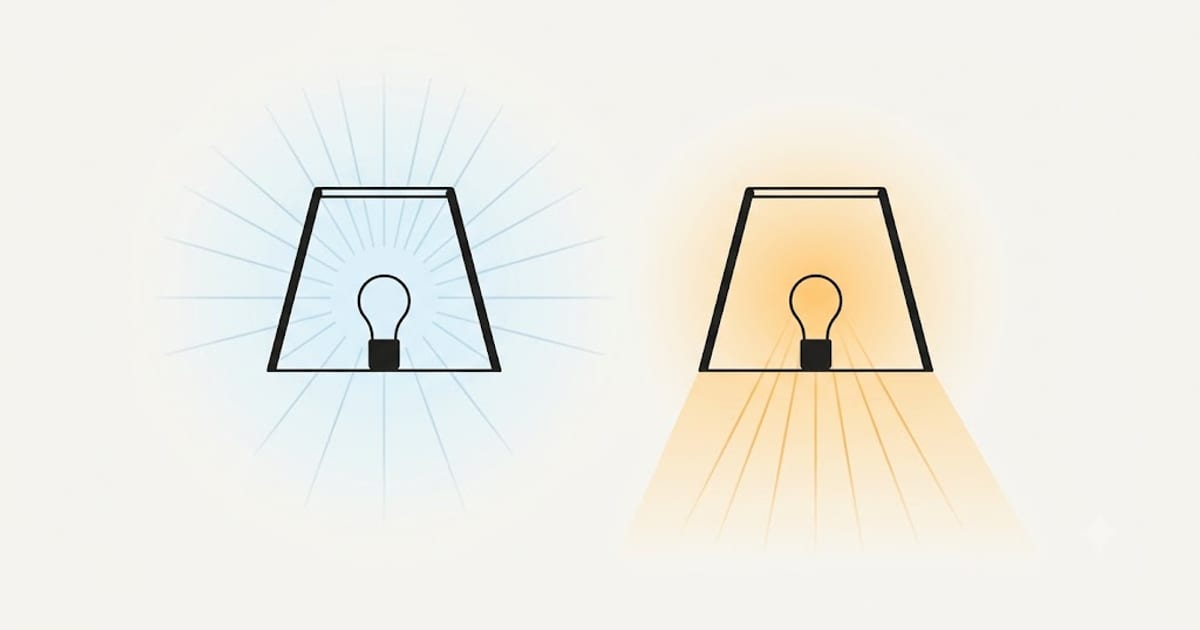
You replaced a 60 W bulb with an 800 lumen LED, which is the correct equivalent, and the room is worse. Nothing is faulty. The equivalence claim was true and it was answering a different question from the one you were asking.
Lumens measure what leaves the bulb in total, in every direction. They say nothing about where it goes.
The main cause: distribution, not quantity
An old incandescent bulb was a small hot filament in the middle of a clear or lightly frosted glass envelope. It radiated in every direction more or less equally — up, down, sideways.
Many LED lamps do not. The chips sit on a flat board facing one way, and even in a bulb-shaped envelope a large share of the output goes forward, in a hemisphere rather than a sphere.
That difference is invisible in the specification and decisive in a fitting.
In a table lamp with a shade, the old bulb threw light up through the open top onto the ceiling, out sideways through the fabric, and down onto the table. Replace it with a forward-throwing LED and the ceiling goes dark, the shade stops glowing, and only the downward pool remains. Same lumens, and the room reads much dimmer, because most of what you were seeing was indirect.
In a downlight, the opposite happens. The old bulb wasted half its output into the housing; the LED sends nearly all of it downward. The same lumen figure reads brighter.
What to look for instead
The specification that describes this is beam angle, or for bulb-shaped lamps, omnidirectional or a stated beam of 300° or more.
| Marked | Distribution | Suits |
|---|---|---|
| Omnidirectional, 300°+ | Close to a filament bulb | Table lamps, pendants with shades, bare fittings |
| 180–270° | Forward hemisphere | Ceiling fittings, uplighters |
| 60–120° | Wide beam | Downlights, wall washing |
| 25–40° | Spot | Accent, task, high ceilings |
For a shaded lamp, buy omnidirectional and accept the slightly lower efficiency. Filament-style LED bulbs are genuinely omnidirectional by construction, which is one of the few practical arguments for them.
Five other reasons for the gap
The lumen figure is optimistic. Cheap multipacks routinely deliver less than the stated figure, and "60 W equivalent" is a marketing statement while lumens is a measurement. Where both appear, trust the lumens; where only the equivalence appears, be sceptical.
Colour temperature changes perceived brightness. At identical lumens, cooler light resolves detail better and reads as brighter. Replacing a 2700 K incandescent with a 2700 K LED keeps this constant — but people often step down in colour temperature when they switch, and a warmer replacement can feel dimmer at the same output.
Colour rendering changes perceived brightness too. A CRI 80 lamp flattens saturated colour, and a room whose reds and wood tones have gone slightly grey reads as duller even when a meter says the light level is unchanged.
The old bulb was not producing its rated output. A filament bulb near the end of its life had a thinned filament and blackened glass, so the comparison in your memory is against a bulb that was already down on output. This one cuts the other way and makes the swap look better than it is.
Output falls in a hot fitting. An LED in an enclosed shade runs hot, and LED output drops with junction temperature. A lamp measured at 800 lumens in open air can deliver noticeably less in a sealed globe — and it will not last as long there either unless it is rated for enclosed fixtures.
The fix is usually not a brighter bulb
Three things to try before stepping up in lumens.
Match the distribution. In a shaded fitting, swapping a directional LED for an omnidirectional one of the same output often restores the room completely, and costs the price of one bulb.
Add a source rather than brighten one. Two 500 lumen lamps light a room better than one 1,000 lumen lamp, because the light arrives from two directions and the shadows fill. This is true in every domestic room except a workshop.
Check what the shade is passing. A lined fabric shade transmits perhaps 50–70% of what the bulb produces; a dense one considerably less. If a lamp is under-performing, the shade is often the component to change.
If none of those is the answer, then work out what the room actually needs rather than guessing upward: the method is in lumens per square foot by room, and the conversion from the wattage you remember is on the watt to lumen page.