Landscape Lighting
Low-voltage landscape lighting sized properly — fixture count, transformer rating and the cable gauge that stops the far end of the run going dim.
Low-voltage landscape lighting fails in exactly one way: the fixtures at the far end are dimmer than the ones at the start. It is always voltage drop, and it is always discovered after the cable is buried.
Three numbers, worked out together
Fixture count from run length and spacing. Transformer rating from total load — never run one above 80% of its nameplate, because a transformer at full rating runs hot and heat is what kills them. Cable gauge from voltage drop over the run.
Get any one of the three wrong and the system underperforms in a way that looks like a faulty fixture.
Current is halved, and that is correct
With fixtures spread evenly along a run, the full load current only flows in the first section of cable. By the far end almost nothing is left. Calculating as though the whole load ran the whole distance doubles the apparent drop and sells you twice the copper.
The window is narrow
12 V LED fixtures want 10.5–15 V. Below that they visibly dim and some flicker; above it they fail early. Ten percent drop is the practical ceiling, and it is tighter than the 3% branch-circuit convention would suggest is necessary — because there is no headroom to spare at 12 volts.
Two fixes that cost nothing
Feed from the middle rather than one end. That halves the effective distance and roughly quarters the drop, for the price of a different trench route.
Leave headroom on the transformer. Landscape lighting always grows — one more fixture at the new tree, two more along the path. Sizing to exactly today's load means buying a second transformer next spring.
Multi-tap is compensation, not a substitute
Transformers with 13, 14 and 15 V terminals exist to compensate a long run. They work. But raising the voltage at the source to fix undersized cable also raises it at the near fixtures, which then run hot.
Choosing the fixture type for the job
Voltage drop decides whether the system works. Fixture choice decides whether it looks like anything.
Path lights cast a pool downward from a low head, usually 18–24 in tall. Spaced 8–12 ft apart — closer produces a runway, which is the most common mistake in a front garden. They light the path, not the garden.
Spotlights are directional and used for uplighting a tree, a wall or a feature. Beam angle matters more here than anywhere else outdoors.
Well lights are recessed into the ground, invisible by day, and used for uplighting where a visible fixture would be in the way. They need drainage under them and they collect leaves.
Wash and flood fixtures have a wide beam for lighting a facade or a hedge evenly.
Step and deck lights are low output — often 10–30 lumens — mounted into risers or posts. This is a safety fitting and brightness is a hindrance: anything bright at ankle level is glare in the eyes of someone coming down.
Hardscape or under-cap lights tuck under a wall coping or bench edge and wash the surface below.
A garden lit entirely with one type looks like a car park. Two or three types doing different jobs is what reads as designed.
Beam angle outdoors
Indoors, beam angle affects spacing. Outdoors, it decides whether a fixture does its job at all, because the distances are much greater.
| Beam | Use |
|---|---|
| 10–15° | Narrow spot — tall trees, uplighting a chimney or a column |
| 24–36° | Spot — small trees, statues, single features |
| 40–60° | Flood — shrubs, wide features, small facades |
| 60–120° | Wide flood, wash — walls, hedges, broad facades |
The rule that follows from the geometry: the further the throw, the narrower the beam. A wide flood aimed at the top of a 30 ft tree spills most of its light into the sky and the neighbour's garden and puts very little on the tree.
Connections are the real failure point
Voltage drop is what the design gets wrong. Connections are what fails two winters later, and they cause more callbacks than everything else combined.
Use proper waterproof connectors. Gel-filled or silicone-filled direct-burial connectors rated for the purpose. Twist-on wire nuts wrapped in tape are not waterproof, and a buried joint is where water goes.
Do not bury a joint you can avoid burying. Keep connections above ground where possible, inside a fixture body or a junction box, and record where the buried ones are.
Leave a service loop — a foot of slack cable — at every fixture. Ground moves, roots grow, and a taut cable eventually pulls a connection apart.
Bury the cable properly. Typically 6 in deep, in conduit under anything that will ever be dug, and away from where a spade goes in spring.
Use direct-burial rated cable, not indoor flex. The difference is the jacket, and the jacket is the whole point.
Do not over-light, and do not light the neighbours
The commonest fault in a finished garden is too much light, and it has three causes: fixtures bought on brightness, no dimming, and no consideration of where the light goes after it leaves the fixture.
Aim down, or shield. A fixture aimed upward at a tree should have a shroud or a glare guard so the source is not visible from the house next door or from a bedroom window.
Warm colour, 2200–2700K. Warm light scatters far less in the atmosphere, attracts far fewer insects, and disturbs wildlife less than cool light. It also simply looks better on planting and stone.
Low output. Outdoor eyes are dark-adapted. A 200 lumen fixture that would be trivial indoors is substantial in a dark garden, and most path lights need 30–100 lumens rather than the several hundred often fitted.
Put it on a timer or an astronomical clock, and turn it off at a sensible hour. A garden lit all night serves nobody, costs money, and is the thing neighbours remember.
3 articles
Landscape lighting for a 110 ft run at 10 ft spacing with 7 W fixtures
| Fixtures10 ft apart along 110 ft | 12fixtures |
|---|---|
| Total load12 × 7 W — 7 A | 84W |
| Transformer105 W needed at the 80% rule — never run one at full rating | 120W |
| Headroom leftroom for about 2 more fixtures | 30% |
| Cable size8% drop — 11 V at the far end | 10 AWG |
| — Voltage drop by cable — | |
| 16 AWGthe last fixtures will look dim | 32%8.2 V at the end |
| 14 AWGthe last fixtures will look dim | 20.1%9.6 V at the end |
| 12 AWGthe last fixtures will look dim | 12.7%10.5 V at the end |
| 10 AWGwithin 10% | 8%11 V at the end |
| 8 AWGwithin 10% | 5%11.4 V at the end |
Notes
- Low-voltage landscape lighting fails in exactly one way: the fixtures at the end are dimmer than the ones at the start. 10 AWG keeps the far end at 11 V, inside the 10% the LEDs need.
- Current is halved in this calculation, and that is correct. With 12 fixtures spread evenly, the full 7 A only flows in the first section of cable; by the far end almost nothing is left. Calculating as if all of it ran the whole 110 ft doubles the apparent drop and sells you twice the copper.
- The 80% rule on the transformer is not conservatism. A transformer run at its nameplate rating runs hot, and heat is what kills them — 84 W of load wants a 120 W unit, not a 84 W one.
- Leave headroom deliberately. Landscape lighting always grows: one more fixture at the new tree, two more along the path. There is room for about 2 more 7 W fixtures on this transformer before it needs replacing.
- Feeding the run from the middle rather than one end halves the effective distance and roughly quarters the drop. It is the cheapest fix available and it costs nothing but a different trench route.
- 12 V LED fixtures want 10.5–15 V. Below that they dim visibly and some flicker; above it they fail early. Multi-tap transformers with 13, 14 and 15 V terminals exist precisely so you can compensate a long run — but sizing the cable properly is the better answer.
Landscape lighting run
133 calculations · browse all
- Landscape lighting for a 20 ft run at 6 ft spacing with 3 W fixtures
- Landscape lighting for a 20 ft run at 6 ft spacing with 5 W fixtures
- Landscape lighting for a 20 ft run at 6 ft spacing with 12 W fixtures
- Landscape lighting for a 30 ft run at 6 ft spacing with 4 W fixtures
- Landscape lighting for a 30 ft run at 6 ft spacing with 9 W fixtures
- Landscape lighting for a 30 ft run at 6 ft spacing with 20 W fixtures
- Landscape lighting for a 40 ft run at 6 ft spacing with 5 W fixtures
- Landscape lighting for a 40 ft run at 6 ft spacing with 12 W fixtures
- Landscape lighting for a 50 ft run at 6 ft spacing with 4 W fixtures
- Landscape lighting for a 50 ft run at 6 ft spacing with 7 W fixtures
- Landscape lighting for a 50 ft run at 6 ft spacing with 20 W fixtures
- Landscape lighting for a 60 ft run at 6 ft spacing with 5 W fixtures
- Landscape lighting for a 60 ft run at 6 ft spacing with 12 W fixtures
- Landscape lighting for a 70 ft run at 6 ft spacing with 4 W fixtures
- Landscape lighting for a 70 ft run at 6 ft spacing with 7 W fixtures
- Landscape lighting for a 70 ft run at 6 ft spacing with 20 W fixtures
- Landscape lighting for a 80 ft run at 6 ft spacing with 5 W fixtures
- Landscape lighting for a 80 ft run at 6 ft spacing with 12 W fixtures
- Landscape lighting for a 90 ft run at 6 ft spacing with 3 W fixtures
- Landscape lighting for a 90 ft run at 6 ft spacing with 7 W fixtures
- Landscape lighting for a 90 ft run at 6 ft spacing with 20 W fixtures
- Landscape lighting for a 100 ft run at 6 ft spacing with 5 W fixtures
- Landscape lighting for a 100 ft run at 6 ft spacing with 9 W fixtures
- Landscape lighting for a 110 ft run at 6 ft spacing with 3 W fixtures
- Landscape lighting for a 110 ft run at 6 ft spacing with 7 W fixtures
- Landscape lighting for a 110 ft run at 6 ft spacing with 20 W fixtures
- Landscape lighting for a 120 ft run at 6 ft spacing with 5 W fixtures
- Landscape lighting for a 120 ft run at 6 ft spacing with 9 W fixtures
- Landscape lighting for a 130 ft run at 6 ft spacing with 3 W fixtures
- Landscape lighting for a 130 ft run at 6 ft spacing with 7 W fixtures
- Landscape lighting for a 130 ft run at 6 ft spacing with 20 W fixtures
- Landscape lighting for a 140 ft run at 6 ft spacing with 4 W fixtures
- Landscape lighting for a 140 ft run at 6 ft spacing with 9 W fixtures
- Landscape lighting for a 150 ft run at 6 ft spacing with 3 W fixtures
- Landscape lighting for a 150 ft run at 6 ft spacing with 7 W fixtures
- Landscape lighting for a 150 ft run at 6 ft spacing with 12 W fixtures
- Landscape lighting for a 160 ft run at 6 ft spacing with 4 W fixtures
- Landscape lighting for a 160 ft run at 6 ft spacing with 9 W fixtures
- Landscape lighting for a 170 ft run at 6 ft spacing with 3 W fixtures
- Landscape lighting for a 170 ft run at 6 ft spacing with 7 W fixtures
- Landscape lighting for a 170 ft run at 6 ft spacing with 12 W fixtures
- Landscape lighting for a 180 ft run at 6 ft spacing with 4 W fixtures
- Landscape lighting for a 180 ft run at 6 ft spacing with 9 W fixtures
- Landscape lighting for a 190 ft run at 6 ft spacing with 3 W fixtures
- Landscape lighting for a 190 ft run at 6 ft spacing with 5 W fixtures
- Landscape lighting for a 190 ft run at 6 ft spacing with 12 W fixtures
- Landscape lighting for a 200 ft run at 6 ft spacing with 4 W fixtures
- Landscape lighting for a 200 ft run at 6 ft spacing with 9 W fixtures
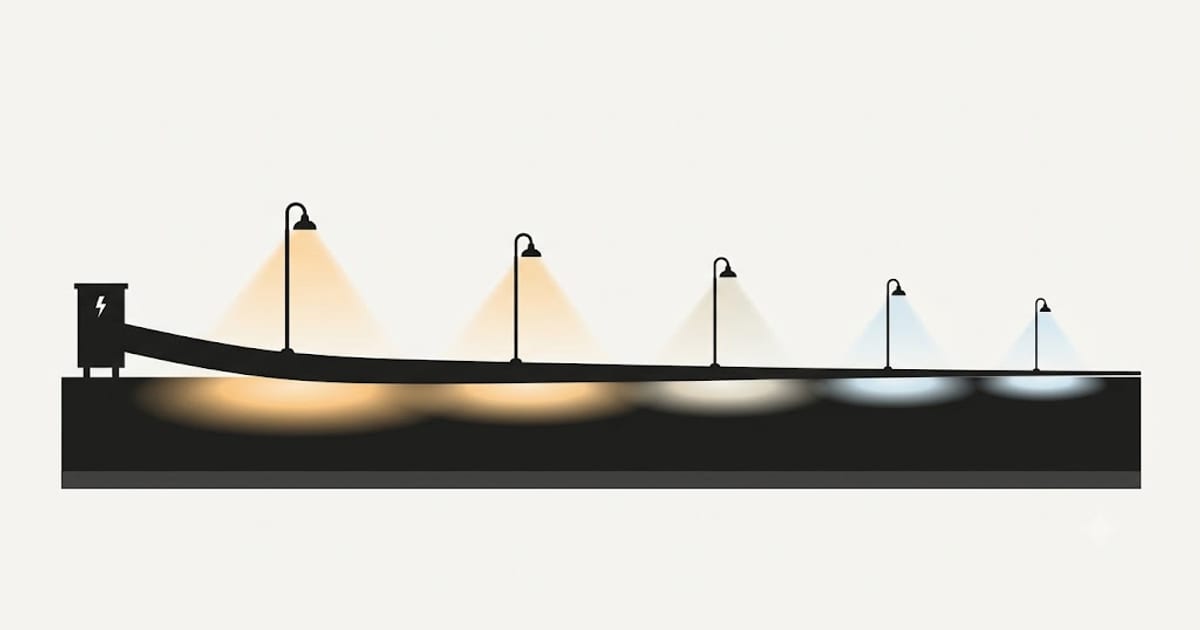 Which Wire Gauge for a Landscape Run, and Why Bigger Is Usually Right
Cable is the cheapest part of the system while the trench is open and the most expensive part once it is closed. Size it for the garden you will have, not the one you are building.
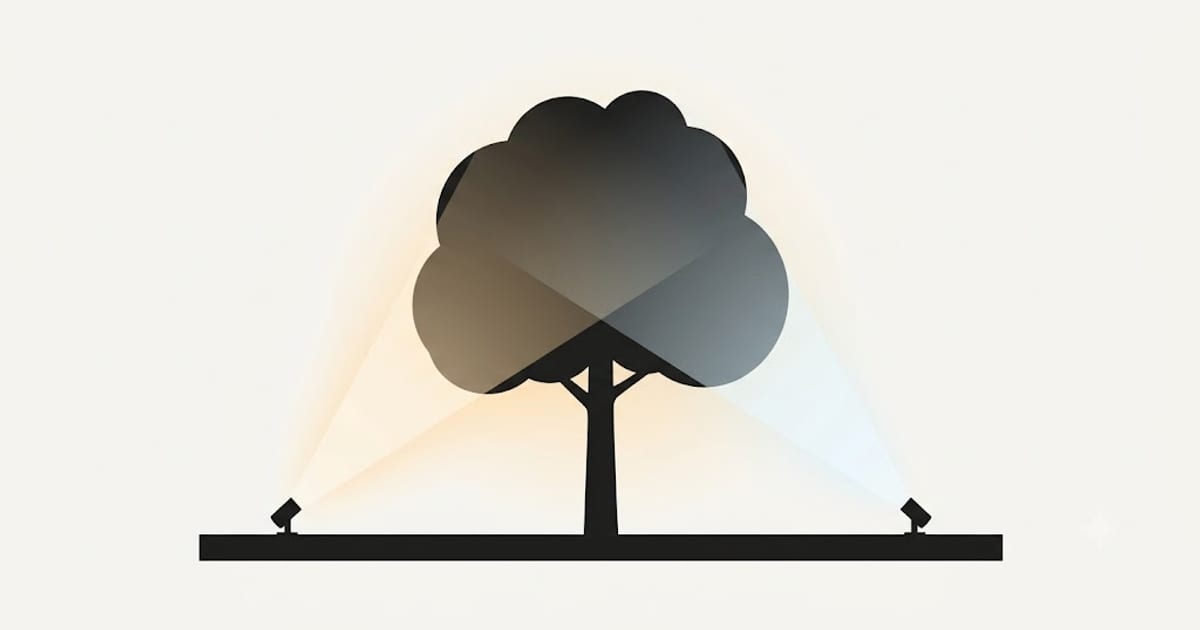 Uplighting a Tree: How Many Fixtures, What Beam, and Where to Stand Them
The commonest fault is a single narrow spot jammed against the trunk. Two fixtures set back at the drip line do far more, with less light in anyone's eyes.
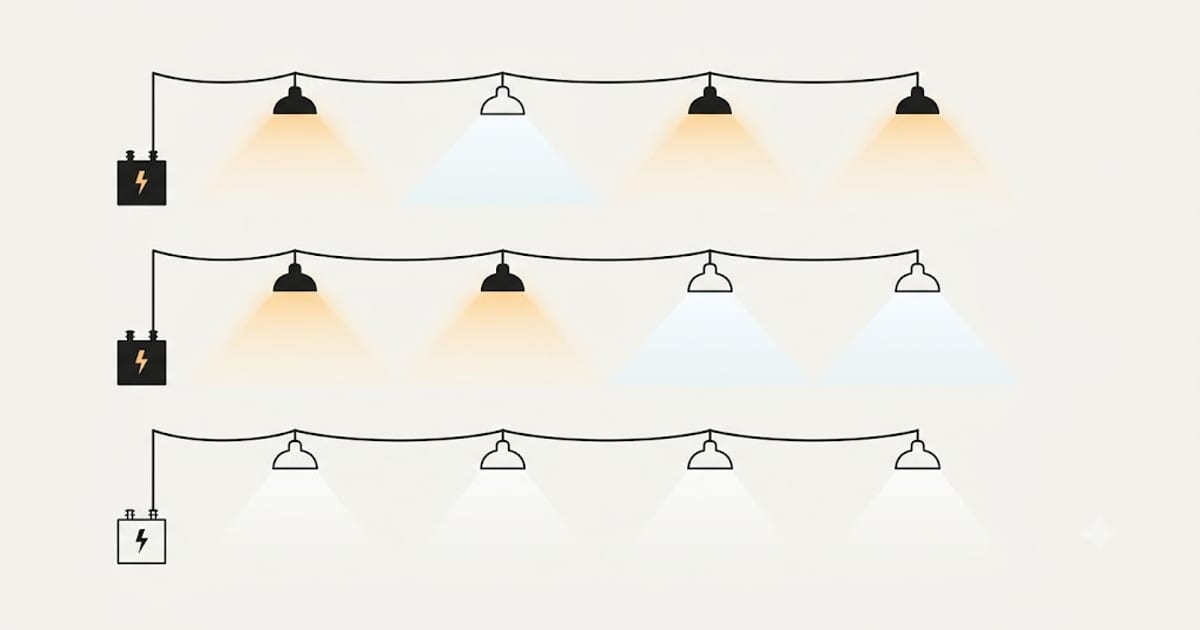 When Half the Garden Goes Dark: Finding the Fault Without Digging
The symptom names the cause. One dead fixture is a connector; a whole run going dim is voltage; everything dark at once is the transformer or its timer.