Watt to lumen equivalent
Watt to lumen equivalent — one page per exact question.
Watts measure what a bulb consumes. Lumens measure what it produces. For a century the two tracked each other closely enough that people used watts as a brightness scale — and LEDs broke that relationship completely.
The equivalence table
These are the figures the FTC lighting label is built on, and they are the reference every "60W equivalent" claim points back to:
| Old incandescent | Lumens |
|---|---|
| 25 W | 250 lm |
| 40 W | 450 lm |
| 60 W | 800 lm |
| 75 W | 1,100 lm |
| 100 W | 1,600 lm |
| 150 W | 2,600 lm |
Note the curve: doubling from 40 W to 75 W does not double the light, and 100 W gives twice the light of 60 W rather than 1.7 times. Wattage was never a linear brightness scale even when it worked.
Efficacy is the number that replaced it
Lumens per watt. An incandescent managed 12–17 lm/W. A modern LED lamp runs 80–120 lm/W, and the efficient end of the market pushes past that.
lumens ÷ watts = lm/W
That single division tells you more about a lamp than the equivalence claim on the front of the box, because "60W equivalent" is a marketing statement while lm/W is a measurement.
Where the equivalence quietly fails
An equivalence claim matches total lumen output. It says nothing about where the light goes. A bare incandescent radiated in every direction; many LED lamps put most of their output forward.
So a "60W equivalent" LED in a table lamp with a fabric shade often reads dimmer than the incandescent it replaced — same lumens, different distribution. In a downlight it reads brighter, for the same reason.
Beam angle decides whether a swap that matches on lumens also looks equivalent in the fitting — an omnidirectional bulb and a reflector lamp of the same output light a room very differently.
The base has to match before anything else does
Lumens are the interesting part of the decision and the base is the part that stops it working. The common domestic fittings:
| Base | Called | Where |
|---|---|---|
| E26 | Medium Edison screw | Standard US lamp holder |
| E27 | Edison screw, ES | Standard European and UK holder |
| B22 | Bayonet, BC | Common UK lamps and ceiling roses |
| E12 | Candelabra | Chandeliers, small US decorative |
| E14 | Small Edison screw, SES | Chandeliers, small European |
| B15 | Small bayonet, SBC | Older UK decorative fittings |
| GU10 | Twist-lock mains spot | Mains-voltage downlights and spots |
| MR16 / GU5.3 | Two-pin, 12 V | Low-voltage downlights, needs a transformer |
| G9 | Small two-pin, mains | Compact fittings, wall lights |
Two traps live in that table. E26 and E27 look identical and are very nearly interchangeable, but not quite — an E27 lamp can sit slightly proud in an E26 holder. And GU10 and MR16 look similar from below and are not interchangeable at all: GU10 is mains, MR16 is 12 V and needs a transformer. Fitting the wrong one either does nothing or destroys the lamp instantly.
Shape codes, and why they matter more than they look
The letter-and-number code describes the envelope, and it decides whether a lamp physically fits and how the light leaves it.
A19 / A60 — the classic pear-shaped general bulb. Omnidirectional. GLS — the same thing under the older British name. BR30 / R63 — reflector shapes, output directed forward. PAR16 / PAR20 / PAR38 — pressed-glass reflectors with a defined beam angle. Candle, golf ball, globe — decorative envelopes, usually lower output. ST64, G80, G125 — filament-style decorative shapes.
The number is the diameter in eighths of an inch (A19 = 19/8 in ≈ 2.4 in) or in millimetres (A60 = 60 mm). It is the number that tells you whether the lamp will foul a shade or stand proud of a fitting.
Reading a lighting label
Most packaging carries a standardised panel. The five fields worth reading, in the order they matter:
Brightness, in lumens. The only measure of how much light you get.
Estimated yearly cost. Derived from the wattage and an assumed tariff, so it is really the wattage in different units.
Life. Almost always stated at L70B50 even where that is not printed — half the units still above 70% output at that point.
Light appearance, in kelvin. A scale from warm to cool.
Energy used, in watts. Divide the lumens by this and you have efficacy in lm/W, which is the honest comparison between two lamps.
What the panel does not carry is the three specifications that separate a good lamp from a cheap one: CRI and R9, flicker percentage, and SDCM. Their absence from the standard label is precisely why cheap lamps compete on the fields that are on it.
Dimmable, enclosed-rated, and the two ratings people miss
Two lines of small print decide whether a lamp survives where you are putting it.
Dimmable. Not all LED lamps are, and a non-dimmable lamp on a dimmer will flicker, buzz, or fail early. Some dimmable lamps also state a minimum dimming level — 1% and 20% are both sold as dimmable, and the difference is the whole evening.
Suitable for enclosed fixtures. A sealed shade traps heat around the driver, and heat is what kills LED lamps. Most lamps are not rated for it, and using an unrated lamp in an enclosed fitting both shortens its life and voids the warranty.
Also worth checking where relevant: damp or wet location rating for bathrooms and outdoors, and operating temperature range for an unheated garage.
Use the calculator above to convert between the wattage you remember and the lumens you now have to buy, then check the base, the shape and those two ratings before ordering.
3 articles
What CFL bulb replaces a 75 watt incandescent?
| Light outputthis is the number to shop by, not the watts | 1,100lumens |
|---|---|
| CFL wattage needed | 18.3W |
| Incandescent wattage | 75W |
| Efficacy assumedagainst 14 lm/W for a filament bulb | 60lm/W |
| Running cost a year3 hours a day at $0.17/kWh — the incandescent costs $13.96 | $3.41 |
| Rated lifeabout 7.3 years at 3 hours a day | 8,000hours |
Notes
- Buy lumens, not watts. A watt is what the bulb consumes; a lumen is what it emits. The habit of shopping by wattage only worked while every bulb was a filament burning at the same efficiency. A 75W incandescent puts out about 1,100 lumens, and any bulb of any technology hitting that number will look the same brightness.
- A CFL reaches 1,100 lumens on about 18.3 watts because it produces roughly 60 lumens per watt against 14 for a filament. Compact fluorescent — takes a moment to reach full brightness.
- Running cost is where the difference actually shows up. At three hours a day and $0.17 per kWh, this bulb costs about $3.41 a year against $13.96 for the incandescent it replaces. Multiply by the number of sockets in the house before deciding it is a small number.
- Packet equivalence claims run a little optimistic — a box marked "60W equivalent" is often 750–800 lumens rather than a clean 800. Check the Lighting Facts panel on the back, which has to print the real figure.
- Brightness is only half the choice. Colour temperature decides whether the room feels warm or clinical, and it is independent of both the watts and the lumens on this page.
Watt to lumen equivalent
32 calculations · browse all
- What LED bulb replaces a 25 watt incandescent?
- What CFL bulb replaces a 25 watt incandescent?
- What halogen bulb replaces a 25 watt incandescent?
- What incandescent bulb replaces a 25 watt incandescent?
- What LED bulb replaces a 40 watt incandescent?
- What CFL bulb replaces a 40 watt incandescent?
- What halogen bulb replaces a 40 watt incandescent?
- What incandescent bulb replaces a 40 watt incandescent?
- What LED bulb replaces a 60 watt incandescent?
- What CFL bulb replaces a 60 watt incandescent?
- What halogen bulb replaces a 60 watt incandescent?
- What incandescent bulb replaces a 60 watt incandescent?
- What LED bulb replaces a 75 watt incandescent?
- What CFL bulb replaces a 75 watt incandescent?
- What halogen bulb replaces a 75 watt incandescent?
- What incandescent bulb replaces a 75 watt incandescent?
- What LED bulb replaces a 100 watt incandescent?
- What CFL bulb replaces a 100 watt incandescent?
- What halogen bulb replaces a 100 watt incandescent?
- What incandescent bulb replaces a 100 watt incandescent?
- What LED bulb replaces a 150 watt incandescent?
- What CFL bulb replaces a 150 watt incandescent?
- What halogen bulb replaces a 150 watt incandescent?
- What incandescent bulb replaces a 150 watt incandescent?
- What LED bulb replaces a 200 watt incandescent?
- What CFL bulb replaces a 200 watt incandescent?
- What halogen bulb replaces a 200 watt incandescent?
- What incandescent bulb replaces a 200 watt incandescent?
- What LED bulb replaces a 300 watt incandescent?
- What CFL bulb replaces a 300 watt incandescent?
- What halogen bulb replaces a 300 watt incandescent?
- What incandescent bulb replaces a 300 watt incandescent?
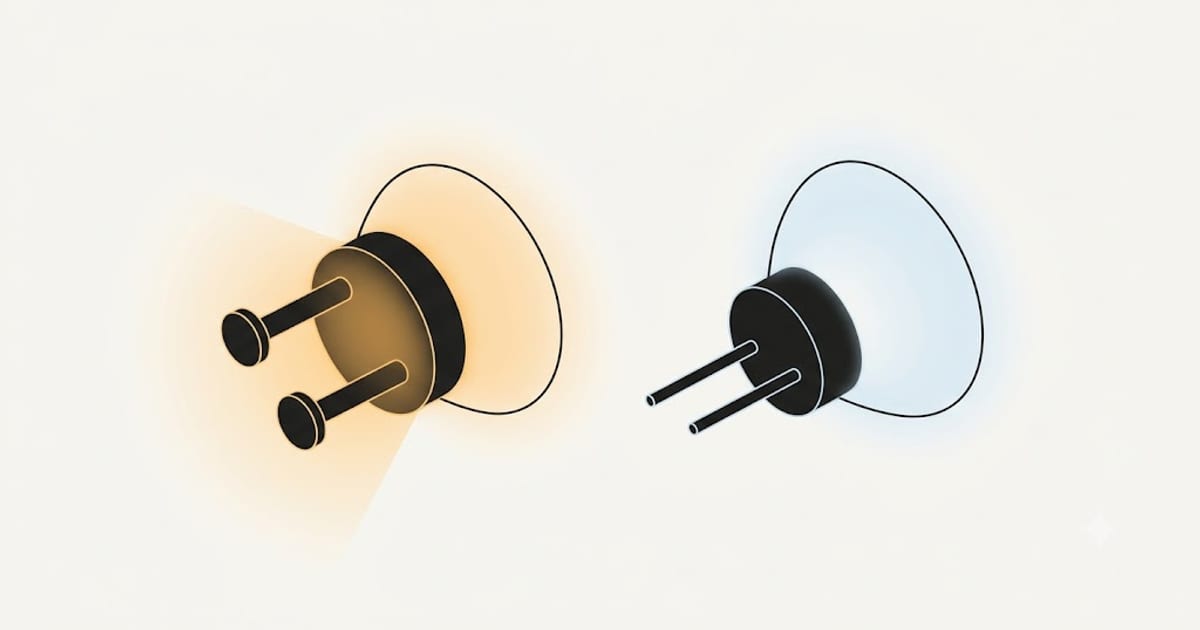 GU10 or MR16? The Two That Look Alike and Are Not Interchangeable
Two pins and a twist versus two pins and a push. One is mains, one is not, and the fitting in your ceiling only accepts one of them.
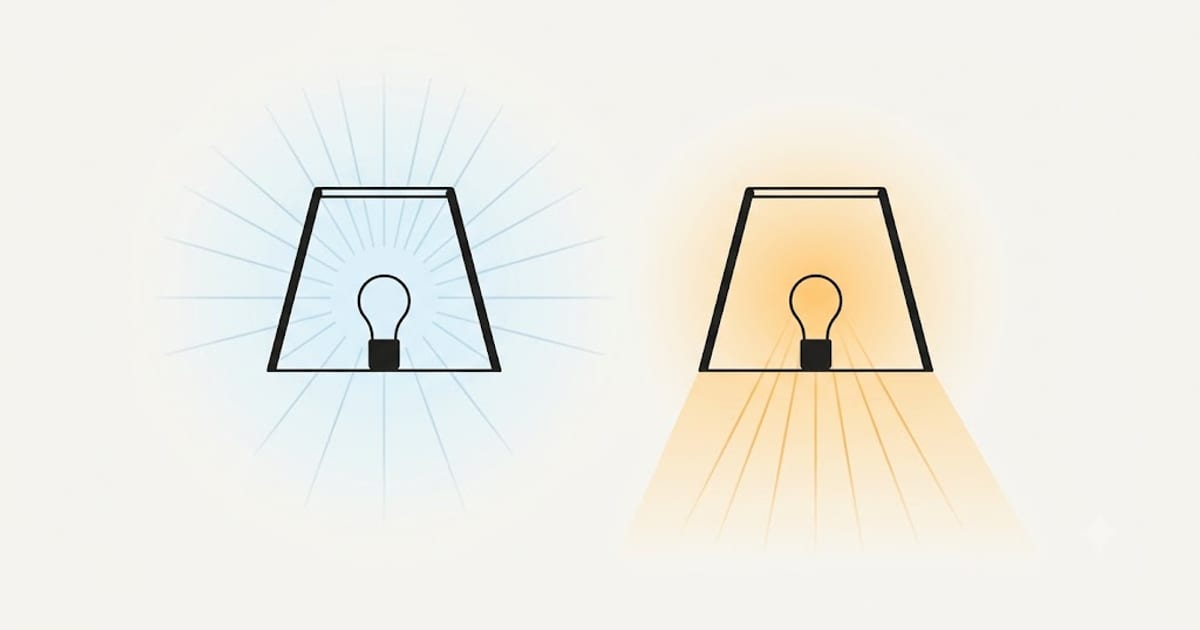 Same Lumens, Less Light — Why an Equivalent LED Disappoints
Lumens measure how much light leaves the bulb. Nothing on the box measures how much of it reaches the thing you are looking at.
 Filament-Style LED Bulbs: What You Gain, and What You Give Up
They solve a problem no other LED solves, and a large share of them fail the one test you can run with a phone camera.