Bathroom Exhaust Fans
The CFM a bathroom actually needs, and the far more useful number: how much of a fan’s rating the ductwork takes away before any air reaches outside.
Bathroom fans are rated on a duct you do not have.
The CFM figure on the box is measured at 0.1 inches of static pressure — short, straight, smooth duct with nothing in the way. A real installation has elbows, a run to the roof or wall, and an exterior cap with a damper.
Each 90° elbow is worth about 15 feet of equivalent straight duct. The wall cap is worth about 30. Two elbows and a cap turn a ten-foot run into something behaving like sixty feet of pipe — and that can cost half the rated airflow.
Rigid duct, not flexible
Corrugated flexible aluminum has roughly three times the resistance of smooth rigid pipe at the same diameter, and it sags between joists into low spots where condensate collects and eventually drips through the ceiling.
If there is one place to spend thirty extra dollars in a bathroom, this is it.
Two ways to size, and the larger wins
By floor area: 1 CFM per square foot, with a 50 CFM floor from ASHRAE 62.2. By fixture: 50 each for a toilet, shower or tub, 100 for a jetted tub.
Below about 100 ft² the area rule governs. Above it, fixtures do — floor area stops predicting how much moisture is actually produced once a room is large.
Vent outside, never into the attic
A fan discharging into an attic puts the entire bathroom's moisture onto the underside of the roof deck, where it condenses. It is one of the most common causes of mold found during a roof replacement, and nothing indicates it until then.
Sone rating decides whether it gets used
Above about 1.5 sones people switch the fan off, and a fan that is off moves no air at any rating. Pair it with a timer and run it twenty minutes after the shower stops.
The control decides whether the fan works
A correctly sized fan on a light switch is a fan that runs for the length of a shower and stops. Moisture keeps leaving surfaces for a long time after that, which is why bathrooms with adequate fans still grow mould in the corners.
A timer is the minimum. Set it for 20 minutes after the switch goes off. Available as a switch replacement, so it needs no work at the fan.
A humidity sensor is better, because it responds to the actual condition rather than to a guess. Set the threshold at around 60–70% relative humidity. The failure mode to know about: a sensor set too sensitive in a humid climate runs continuously in summer. Most units have an adjustment, and it needs setting rather than leaving at the factory value.
A motion sensor plus a timer suits a shared or guest bathroom where nobody will think about it.
Continuous low-speed operation with a boost is the approach ASHRAE 62.2 actually favours for whole-house ventilation. Dual-speed fans run at perhaps 30 CFM continuously and boost to full when triggered. Quiet, effective, and the running cost of a modern DC motor at low speed is trivial.
The pattern behind all four: the fan that runs is worth more than the fan that is rated highest.
A tight house starves the fan
An exhaust fan can only remove as much air as can get back into the room, and in a well-sealed modern house that is less than people assume.
The symptom is a fan that sounds like it is working and moves noticeably less air than its rating — or a bathroom door that pulls itself shut. The measurement is easy: hold a sheet of tissue paper against the grille. It should hold there firmly. If it barely stays, the room is short of make-up air.
Three fixes:
Undercut the door by around 20 mm from the finished floor. The cheapest and usually enough. Fit a transfer grille in the door or the wall above it, where an undercut is not enough or not acceptable. Leave the door ajar while the fan runs, which works and is not a design.
This is also why a fan tested at the factory to 110 CFM can be measured at 60 in a real bathroom without anything being faulty.
The fan is often a light fitting too
Combination units put a light, and sometimes a heater, in the same housing, and the lighting half is usually the weakest part of the specification.
Three things to check before buying one.
Lumen output. Often 500–800 lumens for the whole bathroom, which is under target for anything but a small room. Check it against the room's requirement rather than assuming a ceiling fitting is a ceiling fitting.
Whether the lamp is replaceable. Integrated LED in a fan housing means the whole unit is replaced when the LED fails, and fan motors usually outlive LEDs.
Whether the light and fan can be switched separately. Units wired to a single switch mean the fan runs whenever the light is on, which is either wasteful or exactly what you wanted depending on the room.
Heater versions draw substantial current — often 1.5 kW or more — and usually need their own circuit. That is a decision to make before first fix, not after.
Sizing the duct, not just the fan
Fan CFM and duct diameter are chosen together, and undersizing the duct is the most common way a correct fan underperforms.
| Fan rating | Minimum duct |
|---|---|
| Up to 80 CFM | 4 in |
| 80–150 CFM | 6 in |
| Above 150 CFM | 6 in, or as the manufacturer specifies |
Reducing a 6 in outlet to 4 in duct because that is what is already there throws away a large share of the airflow the fan was bought for. If the existing duct is 4 in and the calculation asks for 100 CFM, either replace the duct or accept that the fan will not deliver its rating.
Two more details that cost nothing at install: slope the duct slightly downward toward the outside so condensate drains away rather than back into the fan, and insulate any run through a cold loft, because warm moist air in a cold pipe condenses inside it and the water goes somewhere.
3 articles
What size exhaust fan for a 9 × 10 ft bathroom?
| Rated size to buy | 130CFM |
|---|---|
| Airflow actually neededset by floor area | 100CFM |
| By floor area90 ft² at 1 CFM per ft², min 50 | 90CFM |
| By fixturestoilet and shower | 100CFM |
| Equivalent duct length10 ft straight + 1 × 15 ft per elbow + 30 ft for the wall cap | 55ft |
| Airflow lost to the ducta 130 CFM fan will move about 111 CFM here | 15% |
| Duct diameterrigid, not flexible — see below | 8″ |
| Room90 ft² | 9 × 10 ft |
Notes
- The number on the box is measured on a duct you do not have. Fans are rated at 0.1 inches of static pressure — a short, straight, smooth duct. Yours has 1 elbow and an exterior cap, which together are worth about 55 feet of equivalent straight duct. That is why a 130 CFM fan moves roughly 111 CFM in this bathroom.
- Rigid duct, not flexible. Corrugated flexible aluminium has around three times the resistance of smooth rigid pipe of the same diameter, and it sags between joists into low spots where condensate collects. If there is one thing to spend the extra thirty dollars on, it is this.
- At 90 ft² the floor-area rule governs, which is the normal case for a bathroom this size. ASHRAE 62.2 puts a floor of 50 CFM under it regardless.
- Vent it outside, not into the attic. A fan discharging into an attic dumps the whole bathroom's moisture onto the underside of the roof deck, where it condenses. It is one of the most common causes of mould found during a roof replacement, and it is invisible until then.
- Run it 20 minutes after the shower stops. A timer switch costs very little and does more for the room than an extra 50 CFM — the moisture is still in the air and in the towels long after the water is off.
- Sone rating decides whether it actually gets used. Anything above about 1.5 sones is loud enough that people turn it off, and a fan that is off moves no air at any rating.
Bathroom exhaust fan
572 calculations · browse all
- What size exhaust fan for a 4 × 4 ft bathroom?
- What size exhaust fan for a 4 × 6 ft bathroom?
- What size exhaust fan for a 4 × 9 ft bathroom?
- What size exhaust fan for a 4 × 12 ft bathroom?
- What size exhaust fan for a 4 × 15 ft bathroom?
- What size exhaust fan for a 5 × 5 ft bathroom?
- What size exhaust fan for a 5 × 8 ft bathroom?
- What size exhaust fan for a 5 × 11 ft bathroom?
- What size exhaust fan for a 5 × 14 ft bathroom?
- What size exhaust fan for a 6 × 4 ft bathroom?
- What size exhaust fan for a 6 × 7 ft bathroom?
- What size exhaust fan for a 6 × 10 ft bathroom?
- What size exhaust fan for a 6 × 13 ft bathroom?
- What size exhaust fan for a 6 × 16 ft bathroom?
- What size exhaust fan for a 7 × 6 ft bathroom?
- What size exhaust fan for a 7 × 9 ft bathroom?
- What size exhaust fan for a 7 × 12 ft bathroom?
- What size exhaust fan for a 7 × 15 ft bathroom?
- What size exhaust fan for a 8 × 5 ft bathroom?
- What size exhaust fan for a 8 × 8 ft bathroom?
- What size exhaust fan for a 8 × 11 ft bathroom?
- What size exhaust fan for a 8 × 14 ft bathroom?
- What size exhaust fan for a 9 × 4 ft bathroom?
- What size exhaust fan for a 9 × 7 ft bathroom?
- What size exhaust fan for a 9 × 10 ft bathroom?
- What size exhaust fan for a 9 × 13 ft bathroom?
- What size exhaust fan for a 9 × 16 ft bathroom?
- What size exhaust fan for a 10 × 6 ft bathroom?
- What size exhaust fan for a 10 × 9 ft bathroom?
- What size exhaust fan for a 10 × 12 ft bathroom?
- What size exhaust fan for a 10 × 15 ft bathroom?
- What size exhaust fan for a 11 × 5 ft bathroom?
- What size exhaust fan for a 11 × 8 ft bathroom?
- What size exhaust fan for a 11 × 11 ft bathroom?
- What size exhaust fan for a 11 × 14 ft bathroom?
- What size exhaust fan for a 12 × 4 ft bathroom?
- What size exhaust fan for a 12 × 7 ft bathroom?
- What size exhaust fan for a 12 × 10 ft bathroom?
- What size exhaust fan for a 12 × 13 ft bathroom?
- What size exhaust fan for a 12 × 16 ft bathroom?
- What size exhaust fan for a 13 × 6 ft bathroom?
- What size exhaust fan for a 13 × 9 ft bathroom?
- What size exhaust fan for a 13 × 12 ft bathroom?
- What size exhaust fan for a 13 × 15 ft bathroom?
- What size exhaust fan for a 14 × 5 ft bathroom?
- What size exhaust fan for a 14 × 8 ft bathroom?
- What size exhaust fan for a 14 × 11 ft bathroom?
- What size exhaust fan for a 14 × 14 ft bathroom?
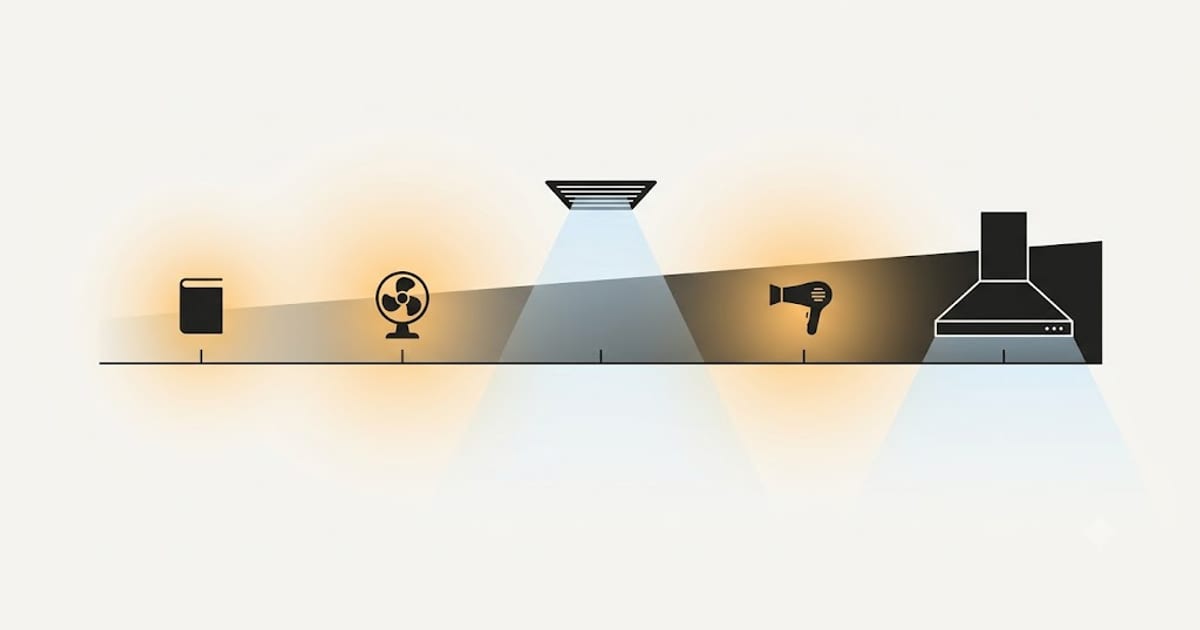 Sone Ratings Explained, and Why 1.5 Is the Number That Matters
A fan that gets switched off moves no air at any rating. The sone figure is the specification that decides whether the fan you bought ever runs.
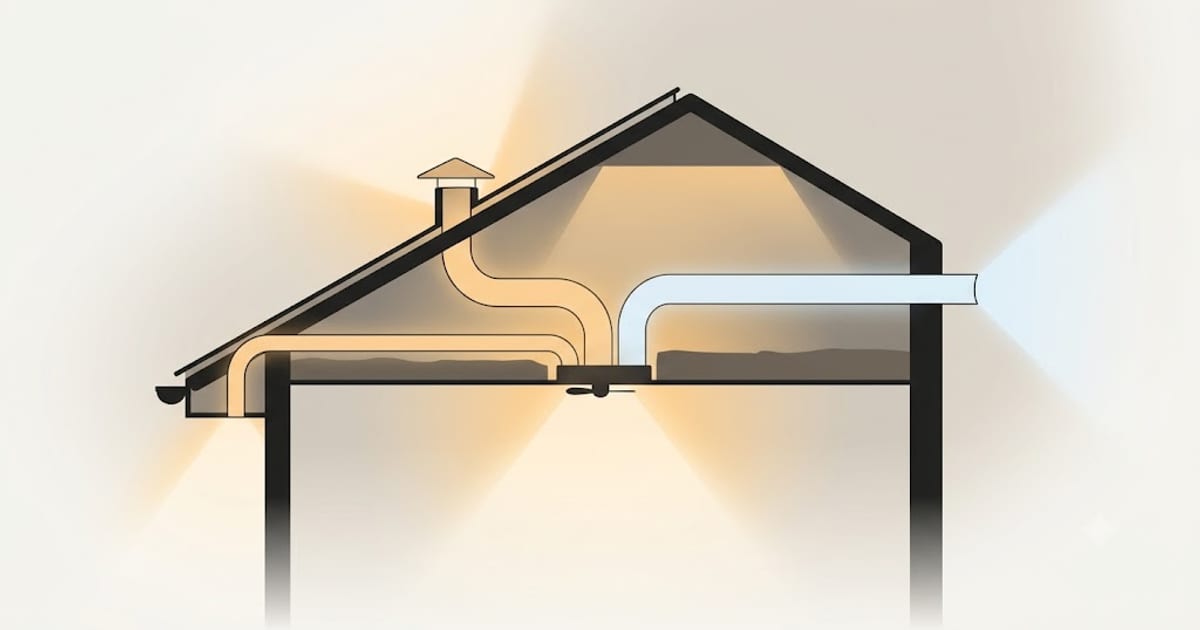 Roof or Wall? Where a Bathroom Fan Should Discharge
Every route out of the house costs airflow and carries a different risk. The shortest one is usually right, and the soffit is usually wrong.
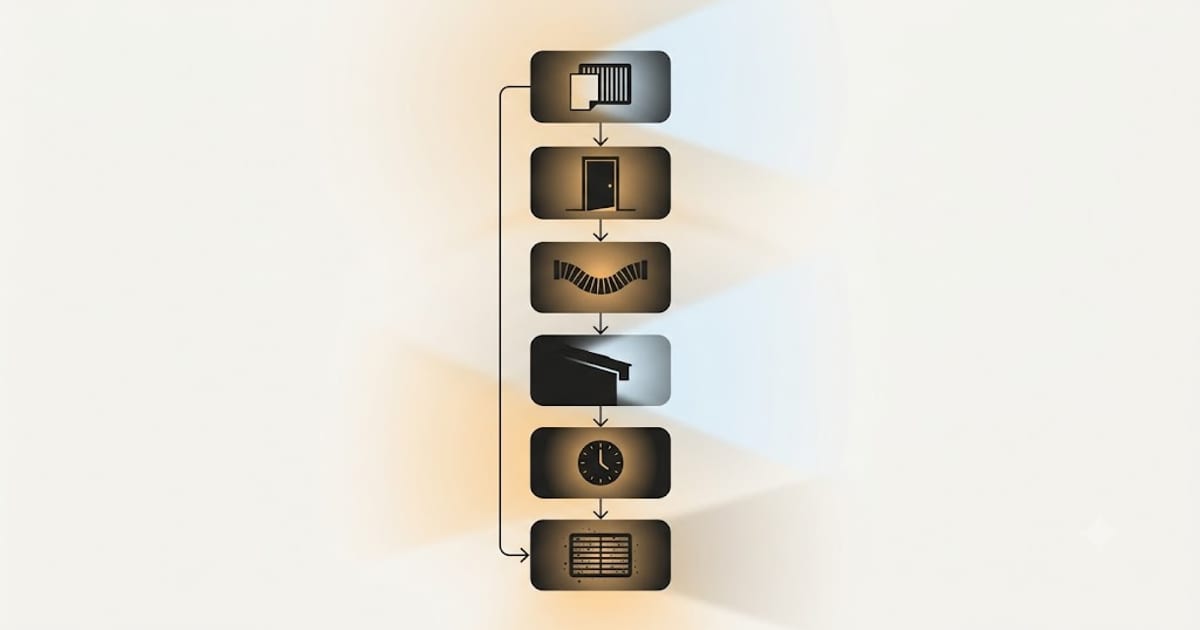 The Fan Runs and the Mirror Still Fogs — Six Causes, in Order
The fan is rarely broken. It is usually starved of make-up air, fighting its own ductwork, or being switched off twenty minutes too early.