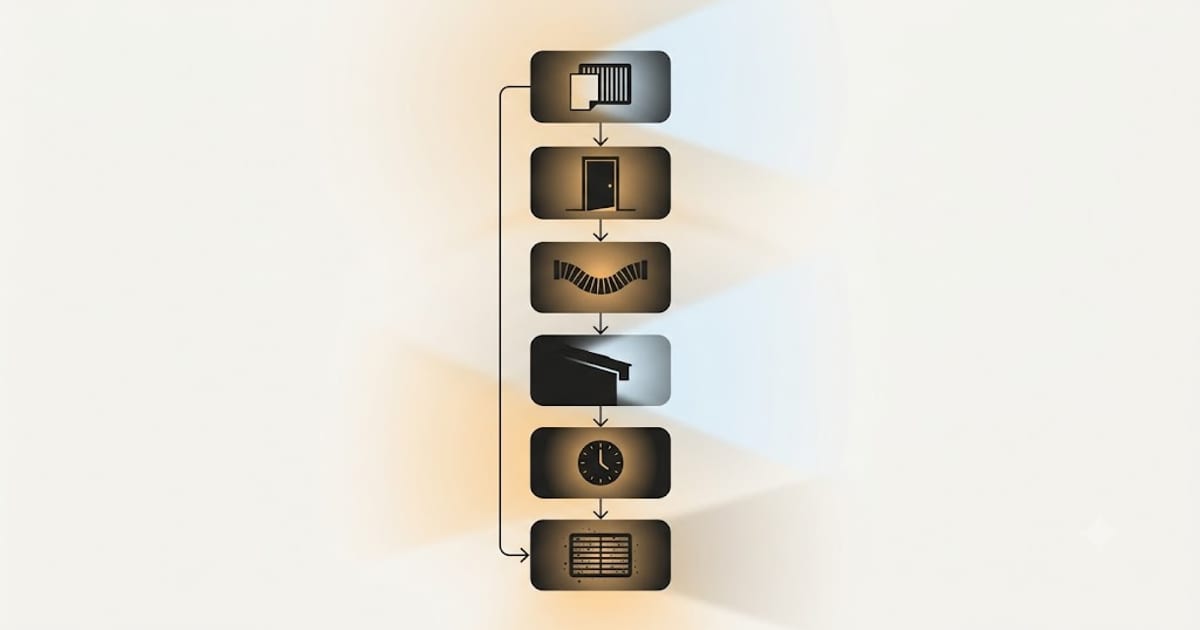
A fan that hums, moves a tissue, and leaves the mirror fogged is almost never a broken fan. It is a fan delivering a fraction of its rating, or running for a fraction of the time it needs to.
Work through these six in order. Each one is a two-minute check, and most bathrooms stop at the first or second.
1. Measure what it is actually moving
Before diagnosing, establish whether there is a problem at all.
Hold a single sheet of toilet tissue flat against the grille with the fan running. It should hold there on its own, firmly. If it holds weakly or falls, the fan is moving substantially less than its rating.
This is a pass/fail test rather than a measurement, and it is enough to tell you whether to keep going. A fan that holds the tissue firmly and still leaves a fogged mirror is a run-time problem, which is cause 5 — skip ahead.
2. The room has no make-up air
The most common cause, and the one people never suspect, because nothing looks wrong.
A fan can only remove as much air as can get back into the room. In a bathroom with a well-fitted door, a carpet seal and no gap at the threshold, there is very little path for replacement air, and the fan spends its effort pulling against a partial vacuum rather than moving air.
The signature is a door that pulls itself shut or resists opening slightly while the fan runs.
Three fixes, cheapest first:
- Undercut the door by about 20 mm above the finished floor. Usually enough on its own.
- Fit a transfer grille in the door or the wall above it where an undercut is not enough or not wanted.
- Leave the door ajar while the fan runs — effective, and not a design.
This single cause is why a fan tested at 110 CFM in a factory can measure 60 in a real bathroom with nothing at all wrong with it.
3. The ductwork is fighting the fan
The rating on the box is measured at 0.1 inches of static pressure — short, straight, smooth duct, nothing in the way. A real installation is nothing like that.
Four things to look for in the loft:
Flexible corrugated duct, which has roughly three times the resistance of smooth rigid pipe at the same diameter. This is the single biggest installation error.
A sag in the run, where condensate collects into a water trap that blocks part of the bore permanently.
A reduced diameter — a 6 in fan outlet joined to 4 in duct because that is what was already there. That reduction alone can cost a third of the airflow.
Tight elbows. Each 90° bend is worth roughly 15 feet of straight duct. Two bends and an exterior cap turn a ten-foot run into something behaving like seventy feet.
4. The outside end is blocked or stuck
Go outside and look at the terminal with the fan running.
The damper flap should be open. Dampers seize shut with paint, corrosion or lint, and a seized damper produces exactly this symptom: the fan runs, the noise is normal, and nothing leaves the building.
Insect mesh clogs. A fine mesh behind the cap accumulates lint from the duct over a few years until it is effectively a filter. This is a gradual failure, which is why the fan "used to work fine".
Birds and nests. A wall or roof cap without a functioning damper is an inviting cavity.
Clean it, and if the mesh is fine enough to clog quickly, replace the cap with one using a coarser mesh or a proper damper.
5. It is not running long enough
If the tissue test passed and the duct is clean, this is the answer, and it is the most common cause overall.
Steam does not stop being produced when the shower stops. Water continues evaporating from wet tiles, a wet floor, wet towels and a full bath for a long time afterward. A fan wired to the light switch runs for the length of the shower and stops at exactly the moment the room has the most moisture in it.
Run the fan for 20 minutes after the shower ends. That single change fixes more fogged mirrors than any hardware.
Three ways to make it happen without relying on anyone remembering:
- A timer switch, set to 20 minutes. Replaces the existing switch, no work at the fan.
- A humidity sensor, set at around 60–70% relative humidity, which responds to the actual condition. Worth adjusting rather than leaving at the factory setting — set too sensitive in a humid climate it runs continuously in summer.
- Continuous low-speed running with a boost, which is what the ventilation standards actually favour. A dual-speed DC fan at 30 CFM continuously costs almost nothing to run and the room never gets to the point of needing rescue.
6. The fan is undersized for the room
Last, because it is the expensive answer and the least often correct.
Two sizing methods, and the larger figure wins: 1 CFM per square foot of floor area with a 50 CFM minimum, or 50 CFM per fixture — toilet, shower or tub — with 100 for a jetted tub.
Below about 100 ft² the area rule governs. Above it, fixture count does, because floor area stops predicting how much moisture is actually produced once a room gets large.
If the room genuinely needs more than the fan can deliver even with clean straight duct and adequate make-up air, replace it — and size the replacement on the equivalent duct length of the route it will actually use, not on the length of the pipe.
The calculator on the bathroom exhaust fan page does that arithmetic, including the elbow and cap penalties.
What none of this fixes
A cold mirror will fog whatever the fan does. An external wall behind a mirror in an unheated bathroom puts the glass below the dew point of the room, and moisture condenses on it faster than any fan can remove it from the air. A heated mirror pad, or heating the room properly, is the fix — not more airflow.
A fan cannot dry a room that has no heat. Ventilation removes moist air; it does not evaporate water off surfaces. A cold bathroom with a well-sized fan will still be damp, because the surfaces stay wet.