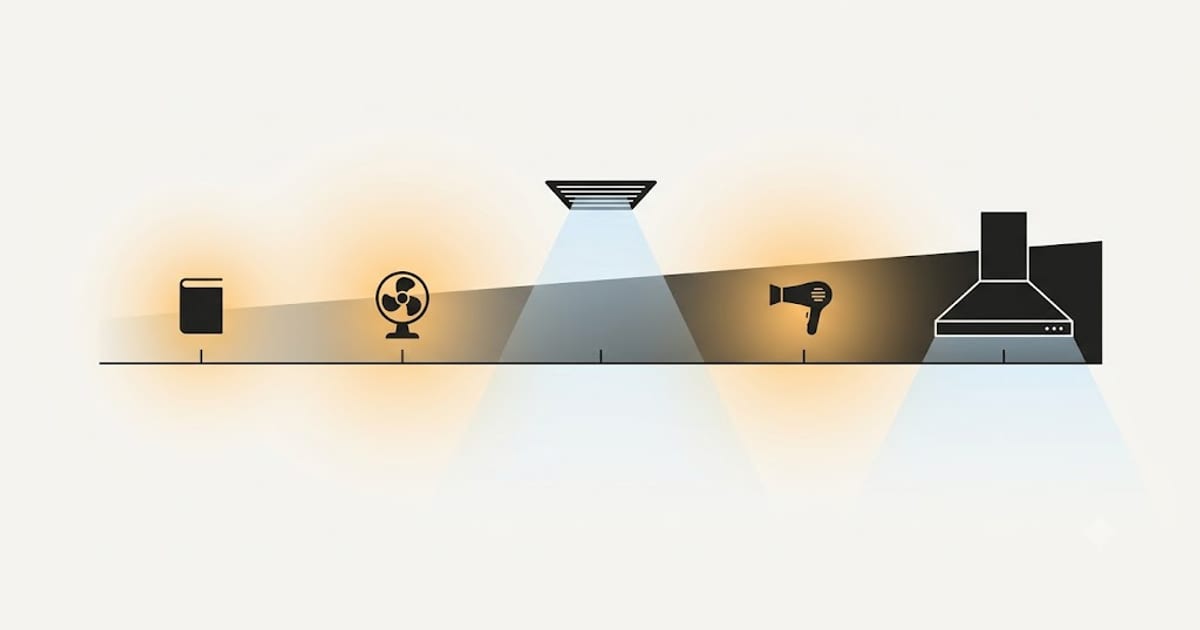
The airflow rating gets all the attention. The sone rating decides whether the fan ever gets used.
Above about 1.5 sones, people switch a bathroom fan off — because it is loud enough to be irritating in a small hard-surfaced room. A fan that is off moves no air at all, which makes it worse than a quieter fan half its rating.
A sone is not a decibel
This is the part that causes confusion, and the difference matters when you compare two products.
Decibels are a logarithmic scale of sound pressure. Ten decibels more is roughly twice as loud, and the relationship between the number and the experience is not linear.
Sones are a linear scale of perceived loudness. Two sones sounds twice as loud as one sone. Four sones sounds twice as loud as two. That is the whole point of the unit — it was built so the numbers behave the way hearing does.
One sone is defined as the loudness of a 1 kHz tone at 40 decibels, which is roughly a quiet refrigerator heard from a few feet away.
The practical consequence: you can compare sone figures directly. A 3.0 sone fan really is twice as loud as a 1.5 sone one, and half as loud as a 6.0. You cannot do that arithmetic with decibels.
What each rating sounds like
| Sones | Comparable to | In a bathroom |
|---|---|---|
| 0.3 | Rustling paper | Barely detectable; you check whether it is on |
| 0.5 | A quiet library | Audible only if you listen for it |
| 1.0 | A quiet refrigerator | Present, unobtrusive |
| 1.5 | A quiet conversation | Noticeable, still tolerable |
| 2.0 | Normal conversation | Intrusive in a small room |
| 3.0 | A running tap | Loud; people close the door on it |
| 4.0+ | An old hair dryer on low | Switched off within a week |
The threshold people actually behave around is between 1.5 and 2.0. Below it, a fan gets left running. Above it, it gets switched off early or never switched on.
Why bathrooms make everything sound worse
The same fan is louder in a bathroom than the specification suggests, and there is a reason that has nothing to do with the fan.
A bathroom is tile, glass, mirror, ceramic and enamel — hard surfaces that reflect sound rather than absorbing it. There is almost no soft furnishing anywhere in the room. Sound bounces repeatedly instead of dying away, so the reverberant level builds well above what the same source would produce in a carpeted bedroom.
The room is also small, which puts you close to the source, and it is usually quiet otherwise, so there is no background noise to mask the fan.
Two practical consequences. Buy quieter than you think you need — a rating that would be unremarkable in a utility room is intrusive in a bathroom. And a fan tested at 1.5 sones on a manufacturer's rig will subjectively read louder than that once it is in a tiled room on a real duct.
Where the noise actually comes from
Not all of it is the motor, and knowing the split explains why quiet fans cost more.
Motor noise is the mechanical hum. A modern DC brushless motor is substantially quieter than the older AC shaded-pole type, and it is the main reason quiet fans are quiet.
Air noise is turbulence — air moving fast through a restriction. This is usually the dominant component and it is the one installation affects most. A fan pushing against undersized or corrugated duct works harder and roars; the same fan on smooth, correctly sized rigid duct is much quieter.
Vibration is the housing transmitting motor movement into the ceiling structure, which then radiates it into the room below. A fan screwed hard to a joist can be noticeably louder than the same fan mounted on isolating grommets.
That split is why a low sone figure is not a guarantee. A 0.8 sone fan on 4 in flexible duct with two tight elbows will be louder than a 1.5 sone fan on straight rigid duct, because the rating is measured on the manufacturer's ideal installation and air noise is added by yours.
Buying quiet, in order of effect
Oversize the fan and run it slower. A larger fan moving the same air at lower speed is quieter than a small one working hard. This is the single most effective choice and it costs a little more.
Choose a DC motor. Quieter, more efficient, and usually variable-speed, which lets it run continuously at a low, near-silent setting.
Use rigid duct at the full diameter of the fan outlet. Reducing a 6 in outlet to 4 in duct adds both noise and resistance.
Mount on isolators rather than hard to the joist, where the fitting allows it.
Consider a remote inline fan. The motor sits in the loft several feet away from the grille, connected by duct, so almost no motor noise reaches the room. These are the quietest domestic option by a wide margin and the natural answer where a bathroom is next to a bedroom.
The rating is measured at a duct you do not have
One caveat that applies to the sone figure exactly as it applies to the CFM figure: both are measured at 0.1 inches of static pressure, on short straight smooth duct with nothing in the way.
Your installation has elbows, a length of run, and an exterior cap with a damper. That raises the pressure the fan works against, which makes it both move less air and generate more air noise than the label describes.
So the two specifications degrade together, and they degrade for the same reason. Getting the ductwork right is the single change that improves both at once — and it is the part of the job that costs least to do properly at the time and most to fix afterwards.
Use the calculator on the bathroom exhaust fan page to work out the CFM your room actually needs once elbows and run length are counted, then buy the quietest fan that meets it.