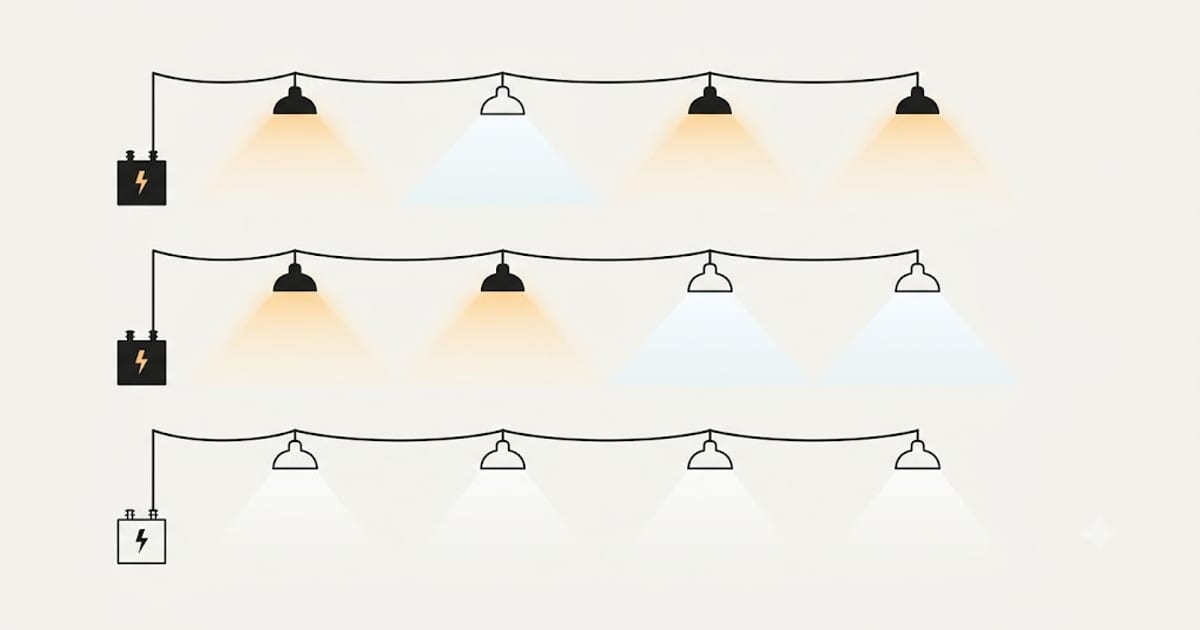
Landscape faults are unusually easy to diagnose, because the pattern of what has failed names the cause almost every time. Work out which of the three patterns you have before touching anything.
Read the pattern first
| What failed | Where the fault is |
|---|---|
| One fixture, others fine | That fixture's lamp, its lead, or its connector |
| Everything past a point on one run | A break or a failed connector at that point |
| A whole run dim but working | Voltage drop, or an overloaded transformer |
| A whole run dead, others fine | That output terminal, its fuse, or the first connector |
| Everything, all runs | Transformer, timer, photocell, or the supply to it |
| Everything, at certain times only | Timer or photocell — not a wiring fault at all |
That table resolves most faults before any tool comes out. The two most misdiagnosed are the last two rows: a system that is dark because the timer has drifted or the photocell is covered in leaves gets attributed to a cable fault, and someone spends a weekend digging.
Start at the transformer, always
Even for a single dead fixture, thirty seconds here rules out the expensive possibilities.
Is there output? Most transformers have an indicator. If not, a multimeter across the output terminals should read somewhere between 11 and 15 V AC.
Is the timer or photocell holding it off? Switch to manual or override. A photocell under a shrub that has grown, or one covered in cobwebs, sees permanent daylight and holds the system off. This is a genuinely common cause of "the whole system died".
Is a fuse or breaker tripped? Many transformers have a resettable breaker per output terminal. A tripped one takes out exactly one run, which is the fourth row of the table.
Is it overloaded? Add up the connected wattage. Above 80% of the nameplate, a transformer runs hot and thermal protection cycles it on and off — which reads as intermittent rather than dead, and is the hardest fault to catch because it works when you go out to test it cold.
One fixture out
The cheapest fault and the most common.
Swap the lamp first if it is a replaceable one. Two minutes, no tools.
Check the connector. This is the answer most of the time. A twist-on wire nut wrapped in tape is not waterproof; a buried joint is where water goes; and corrosion on the copper builds until the connection opens. Cut it back to clean copper and remake it with a gel-filled or silicone-filled direct-burial connector.
Check the fixture lead where it enters the ground. Strimmer damage, spade damage and rodent damage all happen at this point, and the cut is usually visible once you part the mulch.
Swap the fixture with a working one from elsewhere on the same run. If the fault moves with the fixture, it is the fixture. If it stays at that position, it is the cable or the connector there. This one test separates the two possibilities completely and costs nothing.
Everything past a point
A break in the cable, or a failed connector at the last working fixture.
Start at the last fixture that works. The fault is between it and the next one, and the connector at the working fixture is the single most likely point — that is where the cable was cut and rejoined.
Measure voltage at the first dead fixture. Zero volts means the break is upstream. Voltage present but the fixture dead means the fault is the fixture.
Look for recent ground disturbance between the two: a new planting hole, a fence post, an edging strip, a paver lifted and relaid. Cable is almost never cut in the middle of undisturbed ground.
A whole run dim, but lit
This is not a fault. It is a design problem, and the fixtures are telling you the voltage arriving is below what they want.
12 V LED fixtures want 10.5–15 V. Measure at the far fixture with everything running. Below 10.5 and they visibly dim; some drivers begin to flicker at the bottom.
Four things cause it, in order of likelihood: cable too thin for the distance, too many fixtures added to an existing run, transformer running above 80% of its rating, and a corroded connector adding resistance mid-run.
The three fixes that need no digging: move some fixtures to a second output terminal, feed the run from its middle instead of one end if the cable route allows, or step up to a higher transformer tap — remembering that a higher tap raises the voltage at the near fixtures too, so it trims rather than rescues.
The gauge arithmetic is in landscape wire gauge, and the calculator on the landscape lighting page does the drop.
The faults that come back
Two patterns worth recognising, because fixing the symptom does not fix them.
A connector that fails, gets remade, and fails again is sitting in water. Either it is at a low point where the ground stays wet, or the cable jacket is drawing water into it by capillary action from a nick further along. Move the joint above ground into a fixture body or a small junction enclosure, and leave a drip loop so water runs away from rather than into the connection.
A cable that gets cut repeatedly is buried too shallow or in the wrong place. Six inches deep, in conduit under anything that will ever be dug, and routed along a hard edge — a path, a wall, a bed edge — rather than across open ground where a spade goes in spring.
Leave a service loop of about a foot of slack at every fixture when remaking anything. Ground moves and roots grow; a taut cable eventually pulls a connection apart, and that is the fault that appears two winters after a perfect installation.