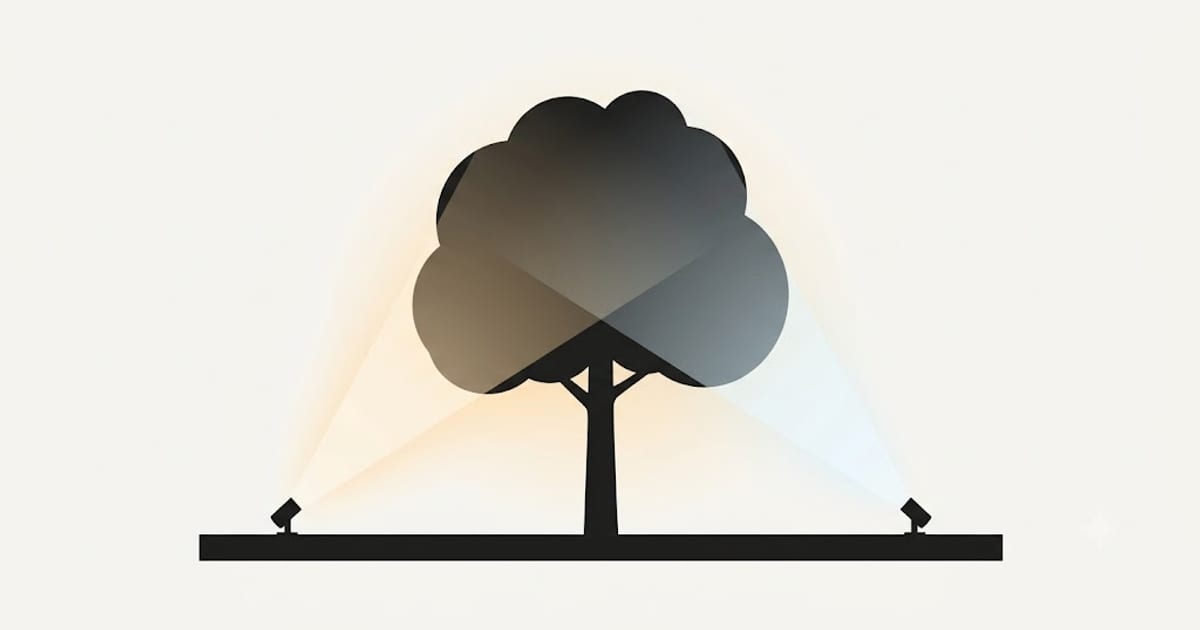
A single spotlight pushed against the base of a trunk produces a bright column of bark and a dark canopy. It is the most common garden lighting installation and close to the least effective one.
Uplighting works when the beam reaches the part of the tree that has shape in it.
Fixture count follows the canopy, not the trunk
The number of fixtures is set by how wide the crown is, because that is what has to be covered.
| Canopy width | Fixtures | Placement |
|---|---|---|
| Under 10 ft | 1 | One side, offset from the trunk |
| 10–20 ft | 2 | Opposite sides, or at 120° |
| 20–35 ft | 3 | Evenly around, at 120° |
| Over 35 ft | 4+ | Evenly around |
Two is the useful minimum for anything with a real crown. A single source lights one side and leaves the other in silhouette, which reads as flat. Two crossing beams give the canopy depth, because the shadowed side of each branch is lit by the other fixture.
Three or more around a large specimen tree turn it into an object you can walk around rather than a facade you view from one direction.
Beam angle is set by height
The taller the tree, the further the light has to travel, and the narrower the beam has to be to still be doing something when it arrives.
| Tree height | Beam angle |
|---|---|
| Under 15 ft | 40–60° |
| 15–25 ft | 24–36° |
| 25–40 ft | 15–24° |
| Over 40 ft | 10–15° |
A wide flood aimed at a 35 ft tree puts most of its output into the sky above the canopy and into the neighbours' windows. It looks like a lot of light and does very little to the tree.
The related rule: columnar trees want narrow beams, spreading trees want wide ones. A poplar or a cypress is a vertical line and takes a 10–15° beam even at modest height. A mature oak with a broad crown takes a wider beam at the same height.
Where to stand the fixture
Placement decides whether the result looks like lighting or like an interrogation.
Set back from the trunk, toward the drip line. Somewhere between a third and the full radius of the canopy. From there the beam travels up through the branches rather than straight up the bark, which lights the structure of the tree rather than a stripe of trunk.
Against the trunk, the beam grazes the bark, exaggerates every ridge, and stops at the first major branch.
Aim slightly across the tree, not straight up. A beam aimed at the far side of the canopy passes through more of the tree on its way, and less of it escapes into the sky.
Two fixtures at 120° rather than 180° look better than directly opposite. Opposed lighting flattens the form back out; an offset pair keeps one side brighter and preserves the sense of depth.
Keep fixtures out of sight lines from seating and windows. A ground spot aimed upward is aimed roughly at eye height for anyone standing further up a slope, and at bedroom windows on the floor above.
Shielding is not optional
An unshielded uplight is a small very bright object at ground level in a dark garden. The eye goes to it instead of to the tree, and everyone who walks past looks straight into it.
Use fixtures with a shroud, a cowl or a glare guard, or fit one. Most quality spotlights offer them and most kits do not include them.
Recess into the ground where the fixture would be in the way — a well light set flush in a lawn or bed disappears entirely by day. They need drainage beneath them and they collect leaves, which is the trade.
Angle away from the viewer. Where a tree is viewed mainly from the house, put the fixtures on the far side aiming back toward it, so the source is behind the trunk from where you sit.
Output, and why less is right
Garden eyes are dark-adapted. The output that reads as generous indoors is glaring outdoors.
For a domestic tree, 200–500 lumens per fixture covers most cases — a small ornamental takes 150–250, a large mature specimen 500–700 per fixture with three or four of them.
Two adjustments. A pale-barked tree needs less than a dark one; birch reflects a great deal more than an old oak. And an isolated tree needs less than one against a bright background, because contrast is doing part of the work.
If in doubt, go lower. Over-lit trees look artificial, and it is the single most common fault in a finished garden.
Colour temperature: warm, and one reason people get it wrong
2700K for most trees. Warm light suits bark and looks natural at the low levels outdoor lighting uses.
3000K where foliage is the point. Slightly cooler light renders green better, so a tree lit for its leaves rather than its structure can take 3000K.
Never above 3000K. Cool light scatters far more in the atmosphere, which produces a visible glow over the whole garden; it attracts substantially more insects; and it disturbs nocturnal wildlife more. It also makes bark look grey.
The mistake is comparing fixtures in daylight, in a shop, where a warm source looks yellow and dull. In a dark garden the same fixture looks correct and the cool one looks like a security floodlight.
Do not light every tree
A garden with every tree uplit has no depth, because nothing is darker than anything else. Pick one or two specimens with real form and leave the rest dark — the contrast is what makes the lit ones read.
The corollary applies to timing: put the whole system on a timer or an astronomical clock and turn it off at a sensible hour. Sizing the transformer and cable for the fixtures you end up with is worked out on the landscape lighting page.