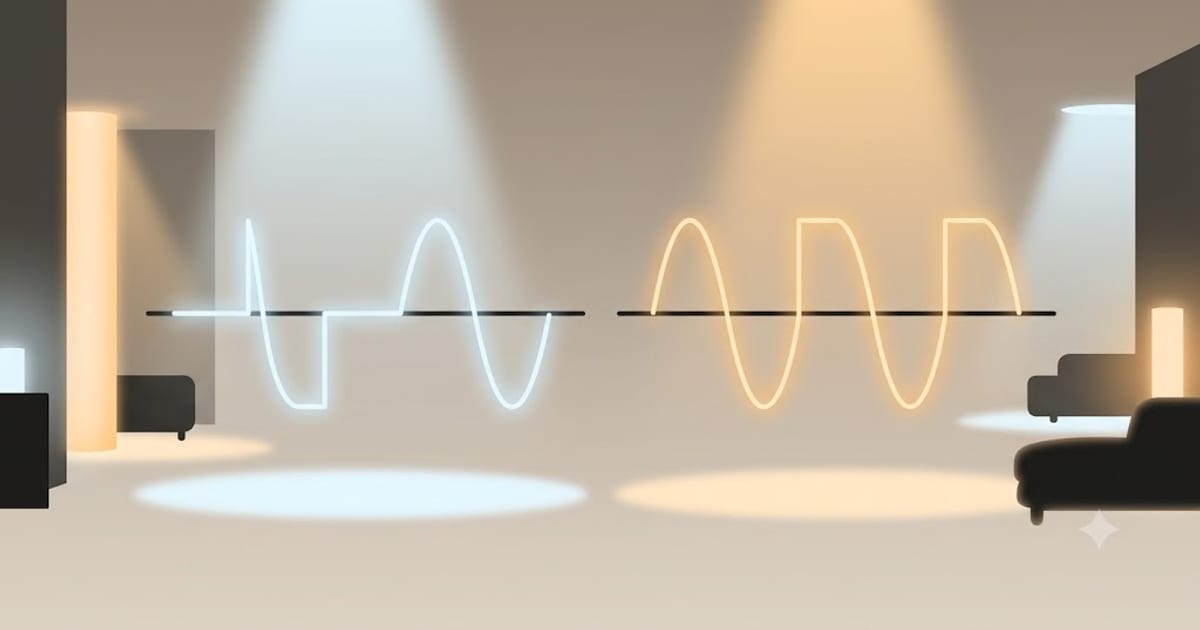
Both types dim by removing part of each mains cycle. They differ in which part, and that difference decides how an LED driver behaves.
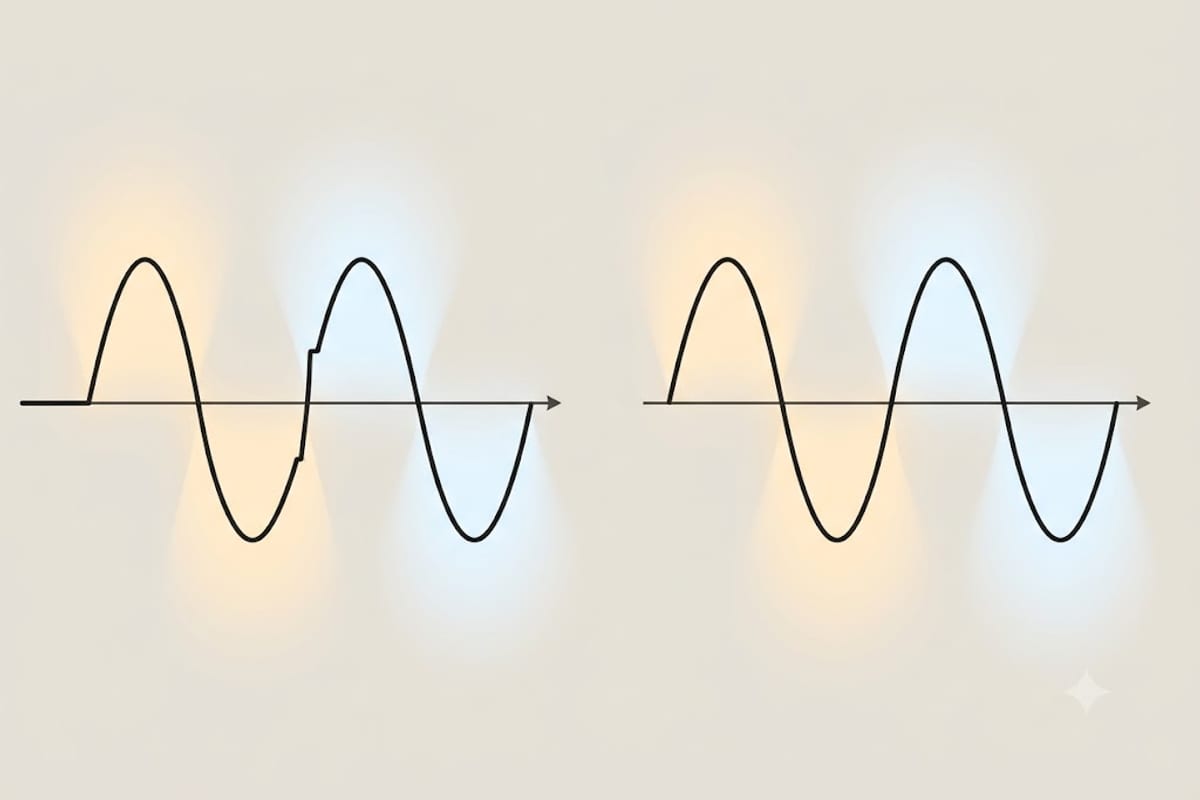
Leading edge
Also called TRIAC or forward-phase dimming. It stays off at the start of each half cycle and switches on partway through, so the waveform begins with an abrupt vertical step.
This was the standard for decades because it suits resistive loads — filament bulbs and wirewound transformers. A filament has thermal inertia and does not care about the sharp switching edge.
That sharp edge is exactly the problem for electronics. It produces a current spike and electrical noise, which is why leading-edge dimmers buzz on LED loads and why the LED driver can be knocked out of regulation by it.
Trailing edge
Also called MOSFET or reverse-phase dimming. It switches on smoothly at the start of each half cycle and off partway through.
Because the turn-on is gradual, there is no inrush spike and far less noise. That suits capacitive and electronic loads — which is what an LED driver is.
Trailing-edge dimmers are quieter, usually dim more smoothly at the low end, and are what modern LED-rated dimmers use.
| Leading edge | Trailing edge | |
|---|---|---|
| Also called | TRIAC, forward phase | MOSFET, reverse phase |
| Cuts | Start of each half cycle | End of each half cycle |
| Designed for | Filament, wirewound transformer | Electronic drivers, LED |
| With LEDs | Buzzing, flicker, poor low end | Smooth, quiet |
| Audible noise | Common | Rare |
| Minimum load | Often high (40 W+) | Usually low (1–10 W) |
| Typical age | Pre-LED installations | Modern LED-rated |
How to tell which one you have
Look at the front. Modern LED-rated dimmers usually say so, and many say "trailing edge" or show an LED symbol.
Listen. A dimmer that buzzes audibly on an LED load, especially in the middle of its range, is almost certainly leading edge.
Check the age. Anything installed before LEDs were mainstream is leading edge unless it was replaced.
Check the minimum load. A high minimum — 40 W or more — points to leading edge. Modern LED dimmers commonly go down to a few watts.
Look for markings inside. Some are stamped with a symbol: a rising ramp for leading edge, a falling ramp for trailing edge.
Which to fit
Fit trailing edge for LEDs. It is the right answer in nearly every domestic case and it fits the same backbox as the dimmer you are removing.
The exceptions are narrow: wirewound (magnetic) transformers for low-voltage halogen genuinely want leading edge, and a small number of LED drivers are specified as leading-edge only. If a driver's datasheet says leading edge, believe it.
Universal dimmers handle both, sometimes with a switch or a learning routine. They are a reasonable choice when the load is mixed or unknown, though a dedicated trailing-edge unit usually gives a slightly better low end.
Fitting one is not the whole job
Two other things decide whether the result is smooth:
Total load against the dimmer's minimum. LED loads are tiny and easy to fall below. See minimum load for an LED dimmer.
All bulbs the same model. Different drivers respond differently to the same chopped waveform, and two brands that each work alone can flicker together.
If flicker persists after fitting a trailing-edge dimmer with an adequate load and matched dimmable bulbs, the bulbs themselves are the remaining suspect — work through why LEDs flicker when dimmed and dimmer compatibility.
Why a leading-edge dimmer buzzes
The buzz is mechanical, and it comes from two places.
Inside the dimmer there is a small choke — a coil on an iron core — fitted to soften the switching edge and keep radio interference down. Every time the TRIAC fires, current slams through that choke, and the magnetic field makes the core laminations physically move. That movement at 100 or 120 times a second is the hum you hear. It is loudest in the middle of the dial, where the switching happens at the steepest part of the mains sine wave and the current step is largest.
The second source is the lamp itself. An LED driver contains inductors and ceramic capacitors, and ceramic capacitors are mildly piezoelectric — they change shape slightly with applied voltage. Feed them a chopped waveform with a sharp edge and they buzz too. This is why replacing the dimmer sometimes moves the noise rather than removing it, and why the fix is a gentler waveform rather than a quieter dimmer.
Trailing-edge dimming removes the sharp edge at source. There is no current step to excite either the choke or the capacitors, which is why trailing-edge units are usually silent on the same load.
What the waveform does to a driver
An LED driver takes mains, rectifies it, and regulates a small constant current into the LEDs. It expects to see a recognisable sine wave for at least part of every half cycle.
A leading-edge dimmer at low brightness hands it a short fragment starting with a vertical edge. Three things go wrong. The driver's input capacitor charges in a violent spike, which stresses it and generates interference. The driver's control loop, which senses the input to decide how hard to run, sees a value that changes abruptly and may hunt. And at deep dim levels the fragment can carry too little energy to keep the driver's own control chip powered, so it resets, restarts, and lights the LEDs in a burst — the "jumps to full at the bottom" symptom.
Trailing-edge dimming hands over a waveform that starts at zero and rises normally, so the driver's front end sees something close to what it was designed for and its loop stays settled.
Universal dimmers and the learning routine
Many modern dimmers are marked universal and can operate in either mode. They decide in one of two ways.
Some detect the load automatically at power-up, measuring how the current responds and choosing a mode. This works well with a straightforward load and can choose wrong on a mixed circuit.
Others have a learning routine — typically holding the button for several seconds until the light blinks, then stepping through modes. The routine is in the instructions and almost always thrown away with the packaging; the manufacturer's website will have it.
If a universal dimmer is behaving oddly on a new load, run the learning routine before concluding anything. A universal dimmer left in leading-edge mode from the previous filament installation behaves exactly like a leading-edge dimmer, because that is what it currently is.
What to write down before you go shopping
Five things, and having them turns a guess into a purchase.
| Write down | Why it decides the choice |
|---|---|
| Number and actual wattage of the bulbs | Sets the load against both limits |
| Whether there is a neutral at the switch | Rules out most smart and some LED dimmers |
| One-way, two-way or three-way | Decides whether you need a companion |
| Exact bulb make and model | Lets you check the compatibility list |
| Existing dimmer make and model | Tells you what mode you are on now |
The bulb model is the one people skip and the one that saves the second trip. With it you can check the manufacturer's tested-dimmer list before buying anything at all — the point made in dimmer compatibility, and still the cheapest five minutes in the job.