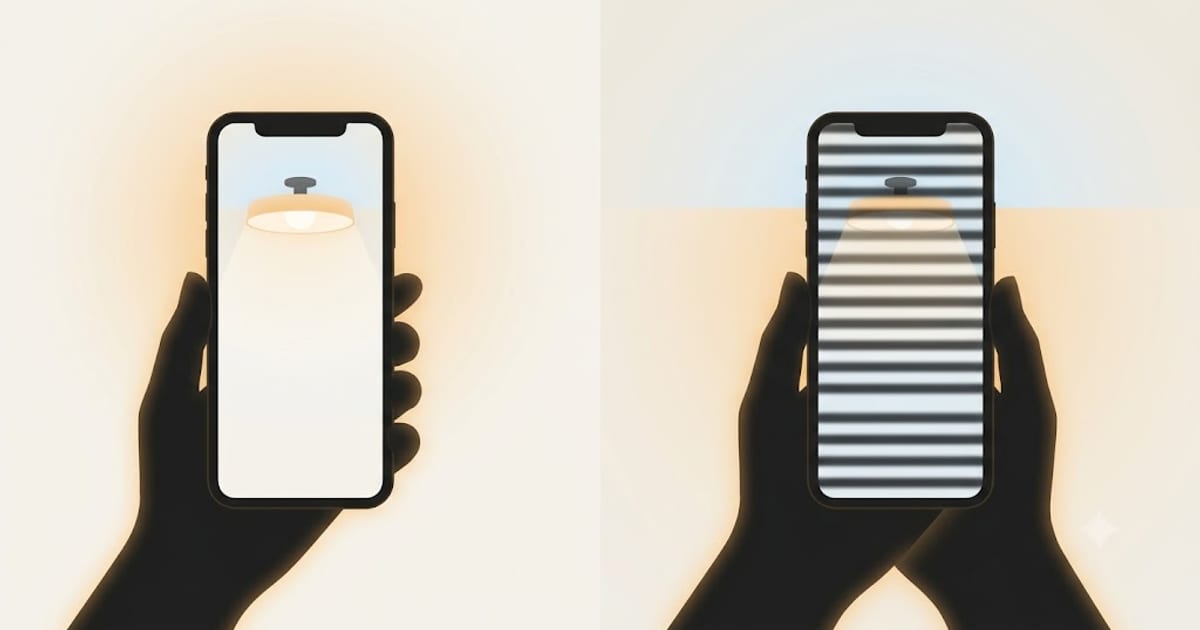
Most LED flicker is invisible — the light pulses far faster than you can consciously see. Your visual system still processes it, and the result shows up as eye strain, headaches after a long evening, or a vague sense that a room is tiring to be in.
Because you cannot see it directly, you need a way to test for it. Two work, and both use things you already own.
The phone camera test
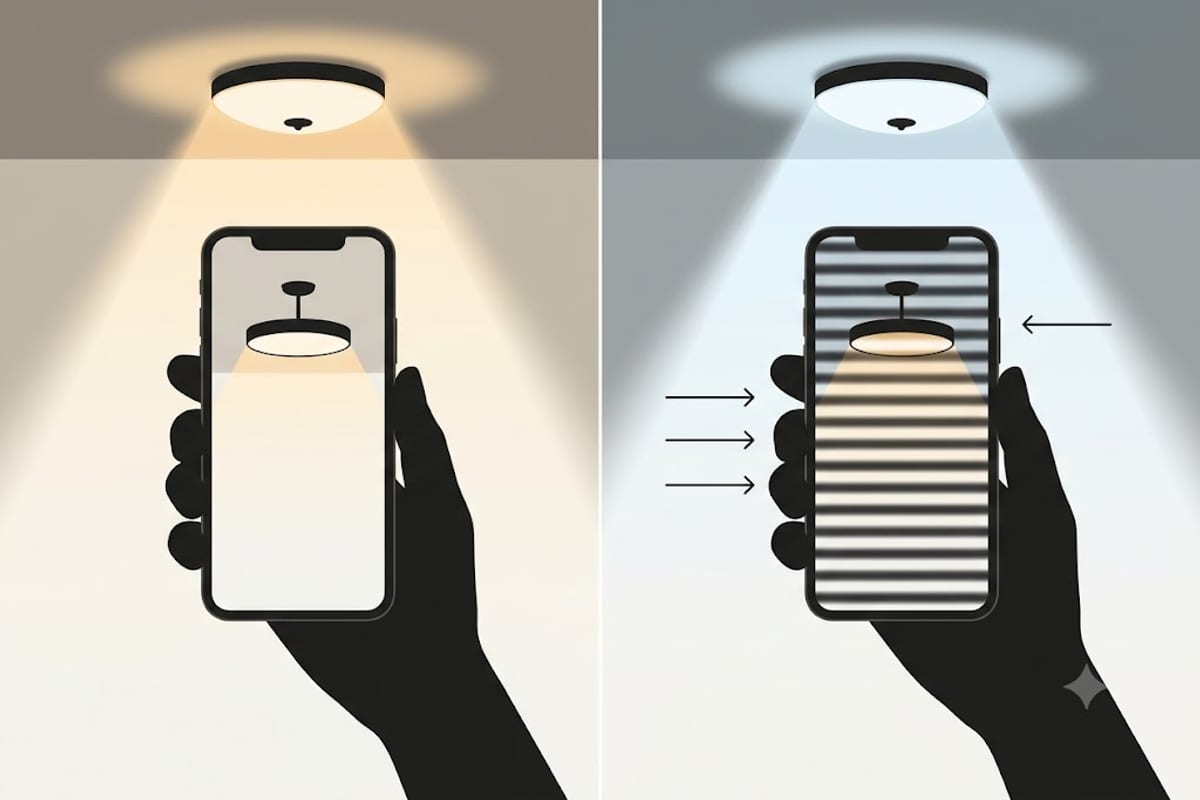
Open the camera, point it at the light, and look at the screen rather than the bulb.
A phone sensor reads the image line by line rather than all at once. If the light is pulsing, different lines are captured at different points in the pulse, and you see horizontal bands rolling across the preview.
Clean image — good driver. Strong banding — the bulb is flickering.
Try it in slow-motion video for a more sensitive result, and test at full brightness and dimmed, since many bulbs are clean at full output and bad when dimmed.
The pencil test
Wave a pencil back and forth quickly under the light and watch the pencil, not the light.
Under a steady source you see a continuous blur. Under a flickering source you see a series of discrete frozen images — a stroboscopic effect, the same thing that makes a spinning wheel appear to stand still.
This test catches lower-frequency flicker, which is the kind most likely to cause symptoms. It works better in an otherwise dark room.
What causes it
An LED chip responds to current essentially instantly. The mains supply alternates, so the job of turning that into steady light belongs entirely to the driver — the electronics in the base of the bulb.
A good driver smooths the supply into near-constant current. A cheap one lets the ripple through, and the light output follows the ripple.
Cheap bulbs flicker because the smoothing components are the easiest place to save money, and the resulting fault is invisible on a shop shelf.
| Situation | Typical cause |
|---|---|
| Flicker at full brightness | Poor driver smoothing |
| Flicker only when dimmed | Dimmer incompatibility |
| Flicker when another appliance starts | Voltage sag on the circuit |
| One bulb in a row flickers | That bulb's driver, or a loose connection |
| Faint glow when switched off | Leakage through a switch with a neon or a smart module |
What to look for on the box
The useful specification is flicker percentage or percent flicker, sometimes given as a flicker index. Lower is better; under 5% is comfortable and under 1% is excellent.
Some manufacturers publish a frequency instead. Above about 3 kHz, flicker stops producing measurable effects in most people even at higher depth, so a high-frequency driver is a good sign.
Most domestic bulbs publish neither. Two practical proxies:
- Bulbs sold for video and photography use almost always have very low flicker, because a flickering light ruins footage. They cost more and are worth it in a room you spend evenings in.
- Very cheap multipacks are where flicker concentrates, along with poor colour rendering and loose colour tolerance. It tends to be the same bulbs failing all three.
Where it matters most
Rooms you spend hours in after dark — living room, home office, bedroom reading light. Symptoms are cumulative, so exposure time matters more than intensity.
Anywhere with rotating machinery, including a workshop or a garage. Stroboscopic effect can make a spinning blade look stationary, which is a genuine hazard rather than a comfort issue.
Anywhere children do homework. Flicker sensitivity varies a lot between individuals, and headaches are easy to attribute to something else.
If it only flickers on a dimmer
That is a different problem with a different fix. The bulb may be fine and the pairing wrong — LED loads are small and behave nothing like the incandescent filaments most older dimmers were designed for.
Start with why LED lights flicker when dimmed, then check dimmer compatibility. Flicker is one of three specifications that separate a good bulb from a cheap one — the others are covered in what CRI you need.
Making the camera test reliable
The phone test works, and modern phones actively work against it. Four adjustments turn an unreliable check into a dependable one.
Use slow-motion video, not the photo preview. Slow motion runs the sensor at 120 or 240 frames a second with a short exposure per frame, which is exactly the condition that reveals banding. The ordinary preview often averages it away.
Turn off HDR and any night mode. Both work by combining several exposures, and combining exposures is precisely how you hide flicker. Many phones also apply anti-banding filtering by default — designed to remove the very artefact you are trying to see.
Move the phone while recording. Pan it in a smooth arc across the light. Motion turns depth of modulation into visible spatial stripes and makes a marginal case obvious.
Test dimmed as well as at full. Most bulbs are cleanest at full output. The level you actually use in the evening is the one that matters.
A bulb showing no banding in slow motion, panned, at the bottom of its dimming range, is genuinely good. One that bands at full output is poor by any standard.
What counts as too much, in numbers
There is a published guideline behind the vague advice, and it explains why frequency matters as much as depth.
IEEE 1789 sets recommended limits as a function of flicker frequency, on the reasoning that faster modulation is less biologically active. It gives a no-observable-effect level and a higher low-risk level, and both scale with frequency.
At the 100 Hz or 120 Hz that mains-driven lighting produces, the no-effect level works out around 3% modulation depth and the low-risk level around 8–10%. At 1 kHz the permitted depth is many times higher, and above roughly 3 kHz the guidance effectively stops constraining depth at all.
That gives two ways for a bulb to be safe, and manufacturers use both: smooth the current properly so depth is low, or switch the driver fast enough that depth stops mattering. A datasheet quoting a switching frequency above 3 kHz is making the second claim, and it is a legitimate one.
| Modulation depth at 100 Hz | Verdict |
|---|---|
| Under 3% | No observable effect |
| 3–10% | Low risk |
| 10–30% | Poor — typical of budget bulbs |
| Over 30% | Bad — visible stroboscopic effect |
The bulbs that flicker 100% by design
One category fails this test completely and sells in large volumes: driver-free AC LED bulbs, most often decorative filament-style lamps and very cheap downlights.
These connect LED strings more or less directly across rectified mains with minimal smoothing. There is no driver to fail because there is barely a driver. They are cheap, they run cool, they last well — and their output falls to zero twice per mains cycle, giving modulation depth at or close to 100%.
They are the worst common offender and they look entirely normal to the eye. The camera test identifies them in two seconds, which is a good reason to run it in the shop before buying a set of six.
The same construction is why some filament-style decorative bulbs cannot be dimmed smoothly and buzz on any dimmer at all.
Fixing a house in the right order
Flicker exposure is cumulative, so the fittings worth replacing first are the ones you sit under longest rather than the ones that flicker worst.
Home office and desk lamps come first — the longest continuous exposure at the closest range, and the place where headaches get blamed on screens.
Living room second, for the same reason across the evening.
Workshop, garage and anywhere with a rotating tool third, and for a different reason: stroboscopic effect can make a spinning blade or chuck appear stationary. That is a safety case, not a comfort one.
Bedrooms and hallways last. Short exposure, and often dimmed low where you are not looking at anything closely.
Landings, cupboards and outdoor fittings do not need replacing on flicker grounds at all.