
A bulb rated 25,000 hours is not promising to work for 25,000 hours. It is promising that at 25,000 hours it will still emit at least 70% of its original brightness — assuming it has not failed for some other reason first.
That standard is called L70, and understanding it explains most of the gap between the number on the box and what happens in your ceiling.
What L70 means
LEDs do not usually burn out the way filaments do. They fade. The phosphor degrades, the chip's output drops, and the light gets gradually dimmer and often slightly cooler in colour.
L70 is the point at which output has fallen to 70% — chosen because that is roughly where the average person starts noticing a room has got dimmer. The fade is slow enough that most people never notice it happening, only that a room that used to feel bright no longer does.
| Rating | At L70, running 3 h/day | Running 8 h/day |
|---|---|---|
| 15,000 h | 13.7 years | 5.1 years |
| 25,000 h | 22.8 years | 8.6 years |
| 50,000 h | 45.7 years | 17.1 years |
Those numbers are also why the rating is not very useful as a purchasing input. Nobody keeps a bulb for 22 years.
What actually kills LED bulbs
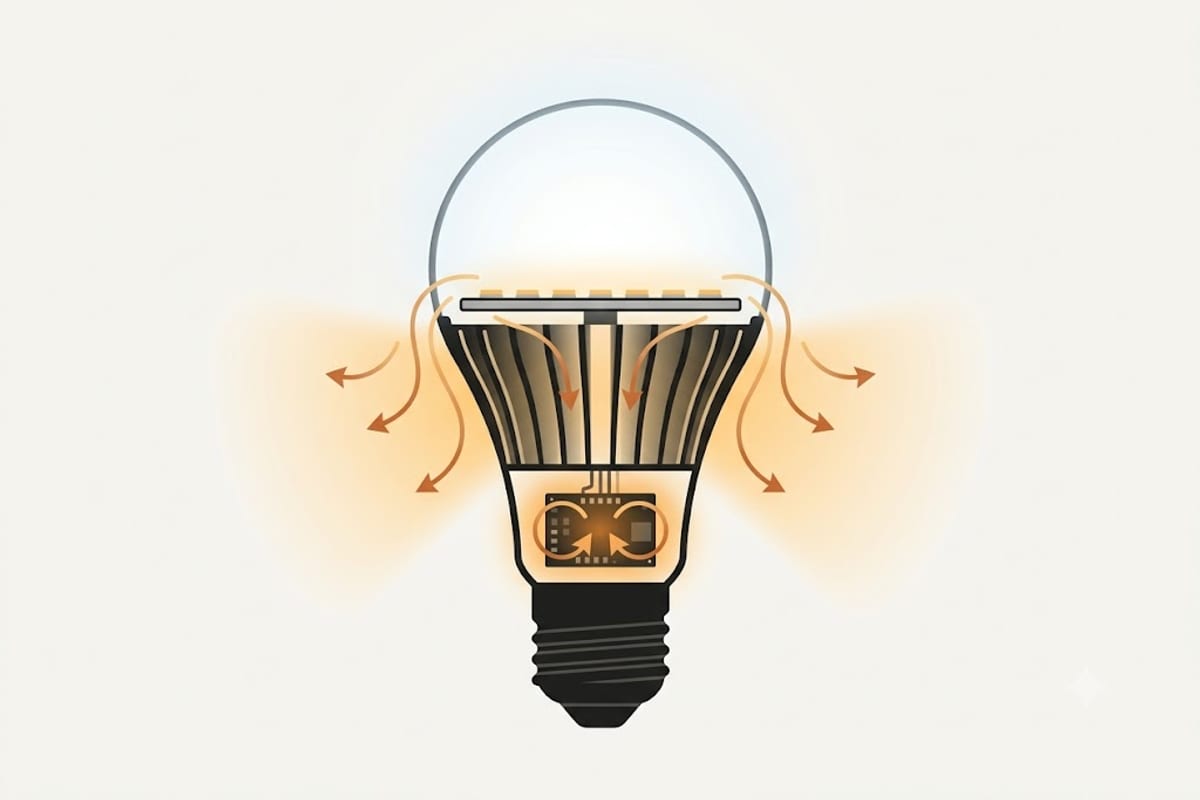
The driver fails first, almost every time.
The LED chip may well last its rated life. The electronics in the base — particularly the electrolytic capacitors — will not, because they sit in a small sealed compartment directly beneath a heat source, and capacitor life falls sharply with temperature.
This is why a bulb rated 25,000 hours can fail in two years, and why the failure is usually sudden rather than gradual: it is not the LED giving up, it is the power supply.
The single biggest factor is heat
Everything that traps heat around the bulb shortens its life:
Enclosed fittings. A sealed glass shade with no ventilation can double the internal temperature. Use bulbs explicitly rated for enclosed fixtures — the rating exists precisely for this and most bulbs do not carry it.
Recessed downlights in insulated ceilings. Insulation packed against the back of a fitting is the worst common case. Use IC-rated fittings and keep the clearance the manufacturer specifies.
Base-up orientation. Heat rises into the driver compartment rather than away from it. A bulb pointing downward from a ceiling runs hotter internally than the same bulb in a table lamp.
Overdriving. Very high lumens from a physically small bulb means high current and high junction temperature. A 1,600 lumen bulb in a standard envelope runs much hotter than an 800 lumen one, and lasts accordingly.
Other things that shorten life
Frequent switching matters far less than for fluorescent, but it does stress the driver's inrush circuitry. Not a reason to leave lights on.
Dimming on an incompatible dimmer. A mismatch can put the driver into a repeated restart cycle that is much harder on it than steady operation. See dimmer compatibility.
Voltage spikes. Cheap drivers have minimal surge protection. A bulb that fails during a storm did not fail from age.
What to look for instead of the hours figure
The hours rating is the least informative number on the box. More useful:
- Enclosed fixture rated, if the fitting is enclosed
- Warranty length — a manufacturer offering five years is making a claim they have to honour, unlike an hours figure
- Physical size of the heat sink — a bulb with real aluminium finning is designed to shed heat; a light all-plastic body at high lumens is not
- CRI 90+ and low flicker, because the brands cutting those corners are cutting driver quality too
If bulbs keep failing in one fitting
Suspect the fitting, not the bulbs. Enclosed shades, insulation contact, a loose connection producing arcing, or a dimmer that the load does not suit will each kill bulb after bulb.
If they fail only on one circuit, and especially if they flicker before failing, the problem is upstream of the bulb.
L70, L80, L90 — and the B number nobody prints
The full notation is LxxByy, and both halves matter.
Lxx is the lumen maintenance threshold: L70 means 70% of original output, L80 means 80%, L90 means 90%. A shorter life quoted at L90 can be a better product than a longer one quoted at L70 — it is being held to a stricter test.
Byy is the proportion of units expected to have fallen below that threshold by the stated time. B50 means half of them. B10 means one in ten.
So "50,000 hours L70B50" means: at 50,000 hours, half the units will still be above 70% and half will not. Almost all domestic figures are B50, and almost none say so. When a specification quotes L70B10, it is a materially stronger claim.
| Notation | Reads as |
|---|---|
| 25,000 h L70B50 | Half are still above 70% at 25,000 h — the usual domestic claim |
| 50,000 h L80B10 | 90% still above 80% at 50,000 h — a serious commercial specification |
| "25,000 hours" alone | Assume L70B50 |
How the number is produced
Nobody runs a bulb for 25,000 hours before printing the box — that is nearly three years of continuous testing on a product with an eighteen-month market life.
The figure comes from two standards used together. LM-80 is the measurement procedure: run the LED packages at controlled temperatures and currents and record lumen output for at least 6,000 hours. TM-21 is the extrapolation: fit a decay curve to that data and project forward.
TM-21 caps the projection at six times the test duration. So 6,000 hours of measurement supports a claim of at most 36,000 hours, and a 10,000-hour test supports 60,000. A box quoting 50,000 hours is standing on roughly 8,300 hours of real measurement at best.
Two limits are worth holding on to. The measurement is of the LED package, not the finished bulb — the driver is not in the test at all, which is precisely the component that fails first. And the test runs at a controlled case temperature that a bulb in an enclosed shade will exceed comfortably.
That is the whole gap between 25,000 hours on the box and two years in a bathroom fitting: a package-level extrapolation, applied to a product whose weakest part was never measured, in a thermal environment the test did not represent.
Colour drifts as well as brightness
Lumen maintenance is only half of ageing. The other half is chromaticity shift — the colour of the light moving over its life.
Phosphors degrade unevenly. The red-emitting phosphor generally fades faster than the yellow, so an ageing warm-white bulb tends to drift cooler and lose R9 as it goes. A bulb bought at 2700K and CRI 90 can be measurably cooler and noticeably worse at rendering skin years later, while still passing L70 comfortably.
You never notice it in a single fitting, because the drift is slow and vision adapts. You notice it immediately when one bulb in a row of six is replaced and the new one is obviously whiter than its five neighbours.
Two consequences. Replace downlights in a row as a set where the colour match matters. And where a manufacturer publishes a chromaticity maintenance figure — often a maximum Duv shift over life — treat it as a good sign about the whole product, because it is not a number anyone quotes unless it flatters them.
Reading a warranty properly
The warranty is the only figure on the box the manufacturer has to honour, so it carries more information than the hours rating. Four things decide what it is worth.
Is there an hours cap? Many warranties are stated as "5 years, based on 3 hours per day". Run the bulb eight hours a day and the cover expires in under two years.
Is it pro-rata? A full-replacement warranty replaces a failed bulb. A pro-rata one refunds a share based on elapsed life, which on a cheap bulb is worth nothing.
What voids it? Enclosed fittings and dimmer use are the two common exclusions, and they are two of the most common domestic situations. A bulb not rated for enclosed fixtures, used in one, has no cover.
Who honours it? A warranty from a brand with a real service address is different from one administered through a marketplace seller.
A five-year full-replacement warranty with no hours cap and no enclosed-fitting exclusion tells you more about expected life than any number of hours printed next to it.