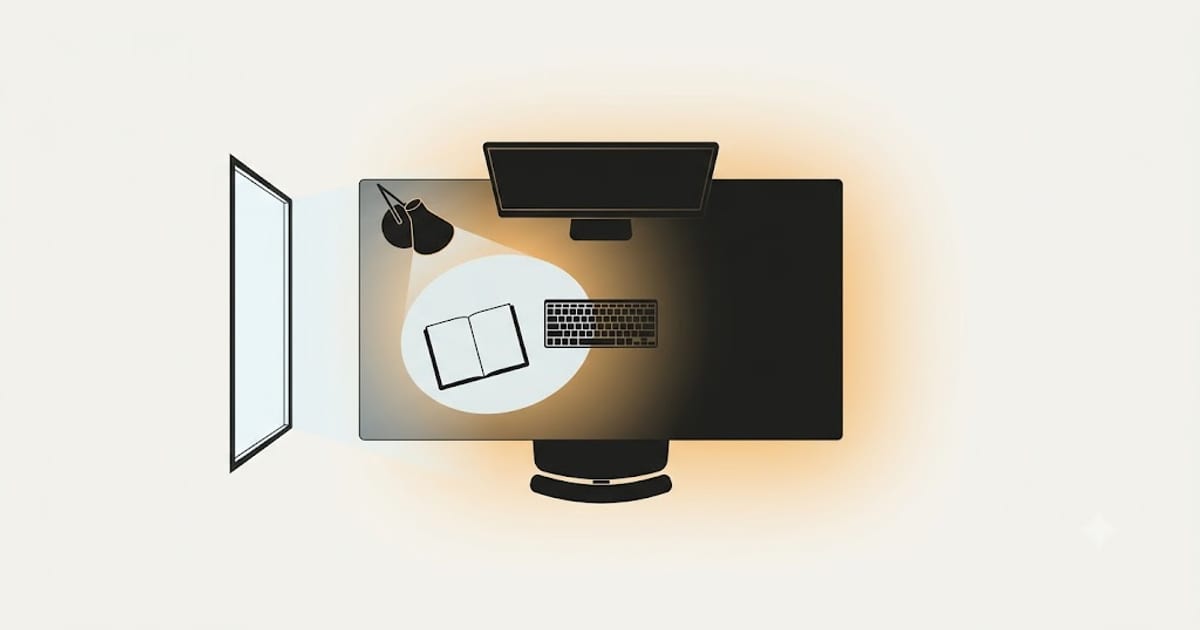
A home office wants 30–50 footcandles on the working surface, which is three to four times what a living room needs and roughly the same as a kitchen.
Multiply by floor area for the room total, and treat the desk as a separate calculation on top.
| Room | General light | Desk task light |
|---|---|---|
| 80 ft² | 2,400–4,000 lm | 400–800 lm on the surface |
| 100 ft² | 3,000–5,000 lm | 400–800 lm |
| 120 ft² | 3,600–6,000 lm | 500–900 lm |
| 150 ft² | 4,500–7,500 lm | 500–900 lm |
| 180 ft² | 5,400–9,000 lm | 600–1,000 lm |
Those are large numbers for a domestic room, and that is the point: home offices are usually converted bedrooms, and a bedroom fitting lights an office at roughly a third of what it needs.
The screen changes the problem
Every other task-lighting situation in a house involves lighting a surface you look at. An office involves a surface that emits its own light, and that changes what the room lighting has to do.
Do not put a bright source behind the screen. A window or a lamp directly behind the monitor means your eyes are adapting to a bright background and trying to read a comparatively dim foreground. That contrast is what produces the tiredness people blame on screen time.
Do not put one directly behind you either. It reflects off the screen into your eyes.
Light the room, not the screen. The goal is that the wall behind the monitor is reasonably lit, so the screen is not a bright rectangle in a dark surround. A wall at roughly a third to a half of the screen's brightness is comfortable; a dark wall behind a bright screen is not.
The window belongs to the side. Desks facing a window and desks backing onto one are both worse than a desk with the window at 90°.
Where the task lamp goes
Two rules, and the second one is the one people get wrong.
Opposite your writing hand. A right-handed person puts the lamp on the left, so the hand does not cast a shadow across what it is writing. This is the whole reason architects' lamps have long arms.
Behind the plane of the screen, aimed away from it. A lamp aimed at the desk from beside and slightly behind the monitor lights the paper without putting a reflection in the display. A lamp in front of the screen, aimed back at you, puts light on your face and glare on the glass.
400–800 lumens is plenty at desk range. An adjustable head matters more than raw output, because the ability to aim it away from the screen is what makes it usable.
Colour temperature, and the argument against 5000K
4000 K is the usual answer for a home office, and it is a compromise worth understanding rather than just accepting.
Cooler light improves fine detail resolution and alertness, which suits work. It also suppresses melatonin, which is fine at ten in the morning and a problem at nine at night — and a home office is the room most likely to be used at both.
Three practical positions:
A room used mainly in daylight hours: 4000 K throughout. Correct, and no downside.
A room used in the evening as well: 3500 K for the general light, with a 4000 K task lamp on the desk. The room stays habitable; the desk stays crisp.
A room that is also a bedroom or a living space: 3000 K general, 4000 K task lamp. Take the compromise on the layer that stops when work stops.
Never 5000 K or above for the room. It reads as clinical, it is unpleasant in the evening, and above 5000 K colour rendering usually gets worse rather than better.
Whatever you choose, keep the general layer at one colour temperature. A task lamp at a different one is the accepted exception because you never look at the source.
Colour rendering matters more than people expect
CRI 90+ in an office, for two reasons that have nothing to do with aesthetics.
If any part of the work involves judging colour — design, photographs, print proofs, fabric, anything on paper that will be reproduced — low CRI light produces decisions that are wrong under daylight.
And contrast on paper is genuinely worse under a poor spectrum. A CRI 80 lamp with low R9 renders black ink on off-white paper with less separation than a full-spectrum source at the same level, which is a small effect that accumulates over eight hours.
The layout that works
A general ceiling layer at the room total, spread across several fittings rather than one, on a dimmer.
One task lamp, adjustable, opposite the writing hand.
Something on the wall behind the screen — a small uplighter, a picture light, a lamp on a shelf. This is the fitting nobody plans and it does more for eye comfort than anything else in the room, because it removes the bright-screen-dark-wall contrast.
Nothing directly overhead in front of you, where it reflects off a glossy screen.
Work the room total out for your own dimensions with the calculator on the room lighting page, which takes the room type and returns the lumens, the fitting count and the colour temperature together. The method and the corrections for ceiling height and surface colour are in lumens per square foot by room.