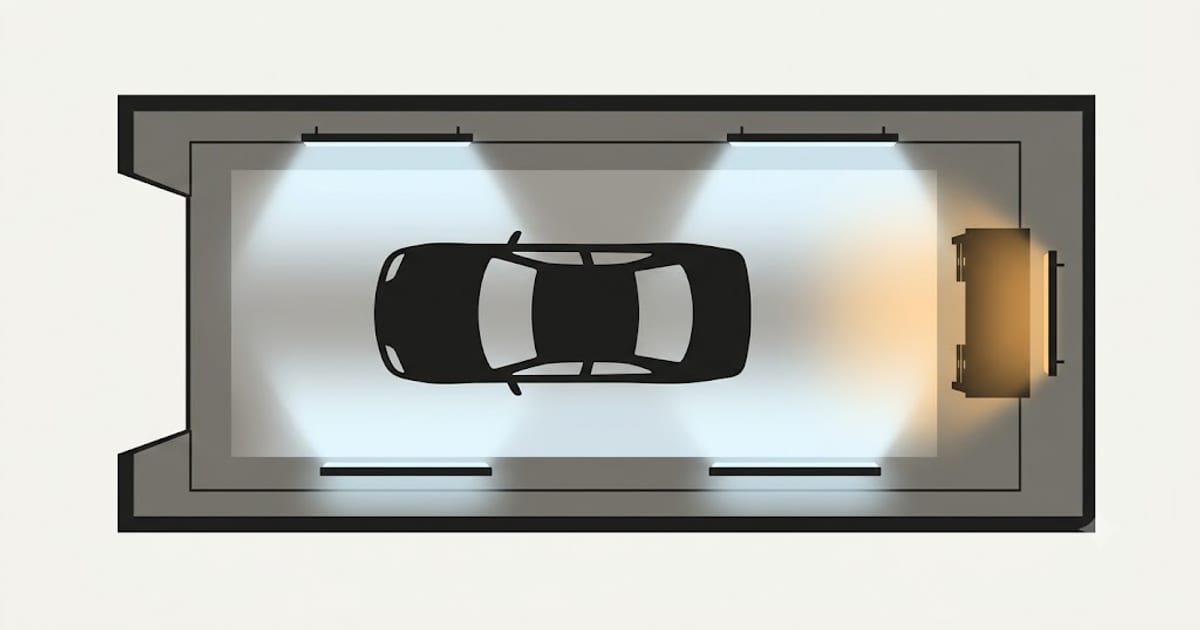
A garage used as a workshop wants 50–75 footcandles — three to five times a living room, and more than a kitchen.
| Garage | Area | Total lumens |
|---|---|---|
| Single, compact | 180 ft² | 9,000–13,500 lm |
| Single, standard | 240 ft² | 12,000–18,000 lm |
| Single, long | 280 ft² | 14,000–21,000 lm |
| Double | 400 ft² | 20,000–30,000 lm |
| Double, deep | 480 ft² | 24,000–36,000 lm |
Those totals are why a single bulb in a porcelain holder — often 800 to 1,600 lumens — leaves a garage feeling like a cave. It is delivering under a tenth of the requirement.
Two corrections apply and both push upward. Garage ceilings are often 9–10 ft, worth 10–20% more. And garages have dark surfaces — bare block, unpainted concrete, a dark floor — worth up to 30% more. A bare-block double garage with a 10 ft ceiling wants roughly 1.5 times the table figure.
The layout rule: over the sides, not down the middle
The commonest garage installation is one row of fittings down the centre line, and it is the wrong place for them.
The centre of a garage is where the car is. Light from directly above the car lands on its roof and bonnet. The strips down each side — where you walk, where the workbench is, where you kneel to work on a wheel — are lit only by what spills past.
Worse, when you lean over anything, you are directly under the light and standing in your own shadow, which is the same geometry that makes a kitchen worktop dark.
Put the fittings over the working strips, one row down each side, roughly above where you walk between the car and the wall. The car gets plenty of spill; you get light coming from the side rather than from directly overhead, which is what puts light into an engine bay or under a wheel arch.
For a double garage, three rows — one down each side and one down the middle between the two bays.
Fittings, not bulbs
A garage lit by bulbs in holders has bright spots and deep shadows, and no amount of extra output fixes the distribution.
LED battens are the right default. A 4 ft or 5 ft linear fitting spreads light along its length, which suits the long narrow shape of a garage and produces even coverage rather than pools.
Typical output is 2,000–5,000 lumens each, so a standard single garage at 15,000 lumens is three to five battens rather than one or two.
High-bay fittings suit ceilings above about 12 ft, where a batten is too far away to spread usefully.
Diffusers matter here. A bare LED batten at 5000 K is uncomfortable to look at, and in a garage you spend a lot of time looking upward from underneath things. A frosted cover costs a few per cent of the output and is worth it.
Check the IP rating. IP20 is fine in a dry attached garage. A detached garage, a workshop where the floor gets washed, or anywhere damp wants IP65.
Colour temperature: this is where 5000 K belongs
A garage is one of the few domestic spaces where cool light is correct rather than a mistake.
4000–5000 K. You are identifying small parts, reading fine markings, judging surface finish and matching colours on wiring. Cooler light resolves detail better, and it stays comfortable at the high light levels a garage needs — the relationship between brightness and comfortable colour temperature works in your favour here.
CRI 90 if you can get it. Not for aesthetics: resistor bands, wire colours, rust versus dirt, and paint matching all depend on honest colour rendering. A 6500 K fitting at CRI 80 renders reds badly, which is exactly the range those tasks live in. Prefer 5000 K at CRI 90 over 6500 K at any price.
LEDs solve the cold-start problem, and that is the real upgrade
The traditional garage fitting was a fluorescent tube, and in an unheated space it started badly. Below about 10 °C a standard tube flickers, starts dim, and can take several minutes to reach full output, because the mercury vapour pressure inside is temperature-dependent.
LEDs behave in the opposite direction. An LED is more efficient cold than warm, so a fitting in a freezing garage starts instantly, at full output, and produces slightly more light than its rating.
That is the strongest practical argument for replacing garage fluorescents, and it has nothing to do with energy.
Two things to check on the specification: the operating temperature range, usually down to around −20 °C, and whether the driver carries the same rating as the light — the limiting component is the driver's capacitor, not the LED.
Task lighting on top
The general layer lights the space. Three positions want their own light regardless of how good it is.
Over the workbench, at 75–100 footcandles, from a fitting mounted at the front edge of any shelf above it — the same front-edge rule that applies to a kitchen worktop, and for the same shadow reason.
A portable or magnetic work light for engine bays, under-car work and anywhere the fixed lighting cannot reach. This is the fitting that gets used most.
Over the door threshold, so the transition from a dark drive is not a step into a bright box.
Work out the total for your own garage on the room lighting page, and the ceiling-height and dark-surface corrections in lumens per square foot by room. Where 5000 K belongs and where it does not is set out in where to use 5000K daylight bulbs.