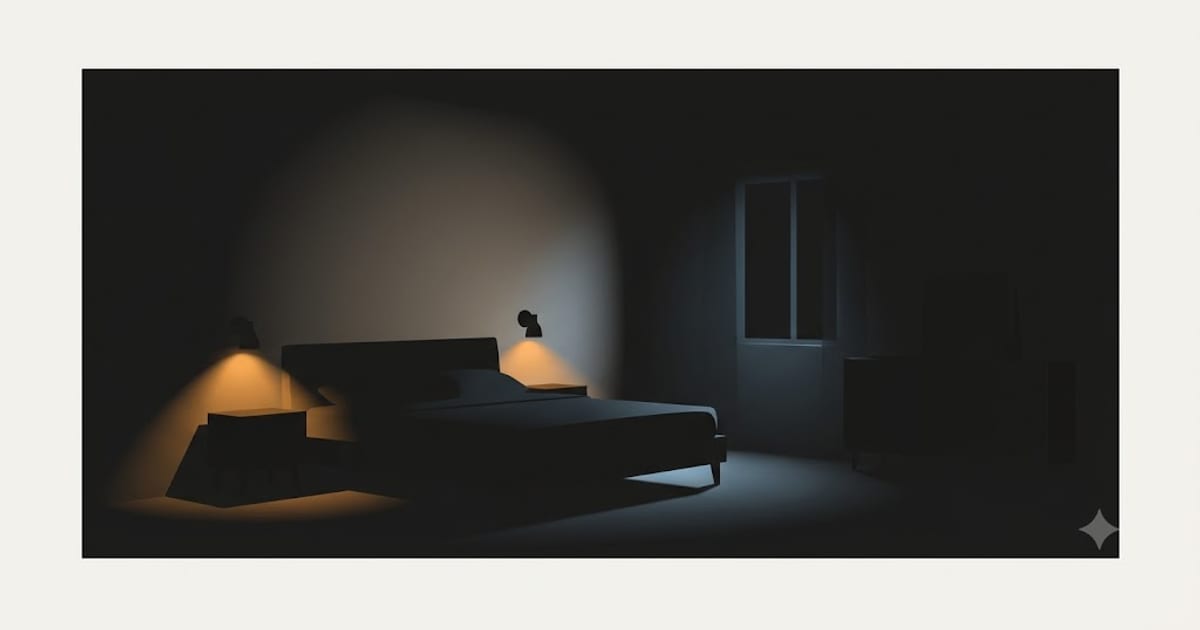
Every other room in the house has a lighting target you try to hit. A bedroom has a range you should usually sit at the bottom of, and a second requirement — the dimmest usable setting — that no lumen figure captures.
The general method is in how many lumens a room needs.
The numbers
10–20 lumens per square foot, and for most bedrooms the lower half of that is right.
| Bedroom | Target range | Usually |
|---|---|---|
| 100 sq ft | 1,000–2,000 lm | ~1,200 lm |
| 120 sq ft | 1,200–2,400 lm | ~1,500 lm |
| 140 sq ft | 1,400–2,800 lm | ~1,700 lm |
| 180 sq ft | 1,800–3,600 lm | ~2,200 lm |
| 220 sq ft | 2,200–4,400 lm | ~2,700 lm |
Reading in bed is a task and wants more — but only over the small area of the book, from a source beside you. That is a bedside lamp of 400–800 lumens, not a brighter ceiling.
Three separate jobs
A bedroom has to do three things at three completely different light levels, which is why a single fitting never satisfies it.
Getting dressed and finding things: 10–20 lm/sq ft. This is the number in the table, and it is the job the ceiling fitting exists for. It is used for a few minutes a day.
Reading: 400–800 lm at the pillow. From a bedside lamp positioned beside and slightly behind the shoulder, so the light falls on the page and not in your eyes. Wall-mounted swing-arm fittings do this better than table lamps because they can be aimed and they free the surface.
Getting up in the night: as little as possible. This is the one that matters most for how the room feels to live in, and it is the one no lumen table has a row for.
The bottom of the range is the real specification
Bright light suppresses melatonin, and the effect is strongest with short-wavelength — bluer — light. A bedroom lit to office levels an hour before sleep works against the room's main purpose.
Practical consequences:
- Warm colour temperature. 2700 K or lower. This is the one room where going warmer than 2700 K is often better rather than merely cosier.
- Low mounting. Light from bedside height feels calmer than the same lumens from the ceiling, because it does not fill the whole field of view.
- A very dim setting that exists. Whether that is a dimmer at the bottom of its range, a low-output nightlight, or a lamp with a low first step, the room needs a level where you can see to move around without waking up properly.
Dimming: check both halves
The bedroom is where dimming is least optional and most often disappointing.
Two separate checks:
- The lamp must state that it is dimmable. Many LED lamps are not, and a non-dimmable lamp on a dimmer flickers or buzzes.
- The dimmer must be LED-compatible. An older dimmer designed for incandescent loads has a minimum load far above what two LED lamps draw, which is why the lights flicker or refuse to go below half.
The symptom people describe as "my LEDs don't dim properly" is almost always one of those two, and swapping the lamp when the dimmer is the problem is the usual wasted step.
Also check how low it actually goes. A dimmer that bottoms out at 20 % is much less useful in a bedroom than one that reaches 5 %, and the spec sheet rarely says.
Layout that works
- Ceiling fitting at the room's target lumens, on a dimmer, for the few minutes a day you need general light. A diffusing shade rather than a bare downlight, because lying in bed you are looking straight at it.
- Two bedside sources, switched independently — this is the detail that matters in a shared room, because one person reading should not require the other to have the light on.
- Nothing aimed at the pillow from the ceiling. A downlight positioned over the head of the bed is uncomfortable to lie under and lights the wrong thing.
- A separate low-level option for the night, ideally on its own switch near the door as well as by the bed.
Wardrobes and mirrors
Two spots inside a bedroom that need more light than the room does:
The wardrobe interior is essentially a small dark task area. A strip inside, ideally on a door switch, at whatever output covers the hanging space.
A dressing mirror wants light on the face rather than on the mirror, which means sources on both sides at roughly face height. Overhead light in front of a mirror puts your features in shadow — the same geometry problem as a kitchen worktop, with the same fix.
What this page does not cover
- The general method and the corrections for ceiling height and surface colour are in how many lumens a room needs.
- Colour temperature in detail, which interacts with wall colour and with the time of evening.
- Smart lighting and scheduling, which can automate the warm-and-dim-at-night behaviour.
- Blackout and daylight control, which is a window problem rather than a lighting one and matters just as much.
Sit at the bottom of the range, keep it warm, and make sure the room has a setting that is nearly off.
Working out what the room already delivers
Before buying anything, it is worth knowing what the existing fittings produce. Most people do not, because the number that used to be on bulbs was watts.
For old filament bulbs, the conversion is fixed and worth memorising:
| Old filament | Lumens | Modern LED |
|---|---|---|
| 25 W | ~220 lm | 2–3 W |
| 40 W | ~450 lm | 4–5 W |
| 60 W | ~800 lm | 7–9 W |
| 75 W | ~1,100 lm | 10–12 W |
| 100 W | ~1,600 lm | 14–17 W |
So a bedroom with one old 60 W pendant and a 40 W bedside lamp was running on about 1,250 lumens — which, for a 140 sq ft room, sits neatly in the 10–20 lm/sq ft band. That is not a coincidence: the bands were calibrated during the era when those were the available bulbs.
The useful consequence is that a room that felt right on filament bulbs is a valid reference point. If a room feels wrong after an LED conversion, the first thing to check is whether the replacements deliver the same lumens the originals did — a "60 W equivalent" LED usually does, but a "60 W equivalent" in a cheap multipack sometimes delivers 650 lm rather than 800.
Shades and fittings eat a large share of it
The lumen figure on a box is the bare lamp output measured in a laboratory sphere. What reaches the room is less, and in a bedroom the gap is bigger than in most rooms because bedrooms use shaded fittings.
Rough delivered fractions:
| Fitting | Reaches the room |
|---|---|
| Bare lamp, open pendant | 90–95% |
| Recessed downlight | 80–90% |
| Open-bottom drum shade | 70–85% |
| Fabric drum shade, lined | 50–70% |
| Enclosed glass or opal globe | 60–75% |
| Dark or opaque shade, uplighting only | 30–50% |
| Small dense lampshade on a table lamp | 30–45% |
A 1,600 lumen lamp in a heavily lined shade delivers something closer to 800. That single factor explains more "this room is too dark" complaints than any error in the lumen calculation.
Two consequences for a bedroom specifically. A shaded bedside lamp needs roughly double the bare-lamp figure you would calculate from the reading target — so 800–1,200 lumens in the lamp to put 400–600 on the page. And a dark shade is a legitimate design choice as long as it is treated as an accent rather than counted toward the room total.
Awkward fittings: fans, sloped ceilings and no ceiling rose
Bedrooms produce more difficult fitting positions than any other room, and the usual answers are worth knowing.
Ceiling fan light kits are almost always under-specified — commonly 800 to 1,200 lumens for a whole room, from a small diffuser at the fan hub. They also sit in the worst possible place for glare, since the fan is centred over the bed. Treat the kit as a partial general layer and plan on bedside sources to carry the room.
Sloped ceilings need either a sloped-ceiling housing or a fitting hung from a rod that keeps the lamp vertical. A standard flush fitting on a slope aims its beam at a wall.
No ceiling rose at all, common in older houses and in loft conversions, is less of a problem than it looks. A bedroom is the one room that works well with no ceiling light at all: two bedside lamps plus one floor lamp bouncing off the ceiling delivers the room target from three low sources, which is the arrangement most bedrooms are better off with anyway.
Plug-in wall lights with a cord run behind the headboard solve the "wall-mounted reading light without an electrician" problem and are worth knowing about before rewiring is considered.
When the bedroom is also something else
A bedroom that doubles as a home office or a nursery has two targets that conflict, and picking a middle value satisfies neither.
Bedroom plus home office. The desk wants 30–50 lm/sq ft on the working surface; the room wants 10–20 overall. Do not raise the room to meet the desk — that leaves a bright room you have to sleep in. Instead put a proper task lamp on the desk, ideally 500–800 lumens with an adjustable head, and leave the room at bedroom level. A desk lamp is also the fitting most easily turned off at the end of the working day, which matters psychologically as much as visually.
Bedroom plus nursery. The conflict is between a changing area, which needs real light and honest colour, and a room that has to stay dark at 2 am. The answer is the same shape: a dedicated, well-specified source over the changing surface, switched separately, plus an amber night light — and nothing bright overhead.
Guest rooms have the opposite problem: they are specified once and then used by people whose eyes may be considerably older than the owner's. Take the top of the range rather than the bottom for a guest room, put it on a dimmer, and make sure there is a bedside light that can be operated without getting up.