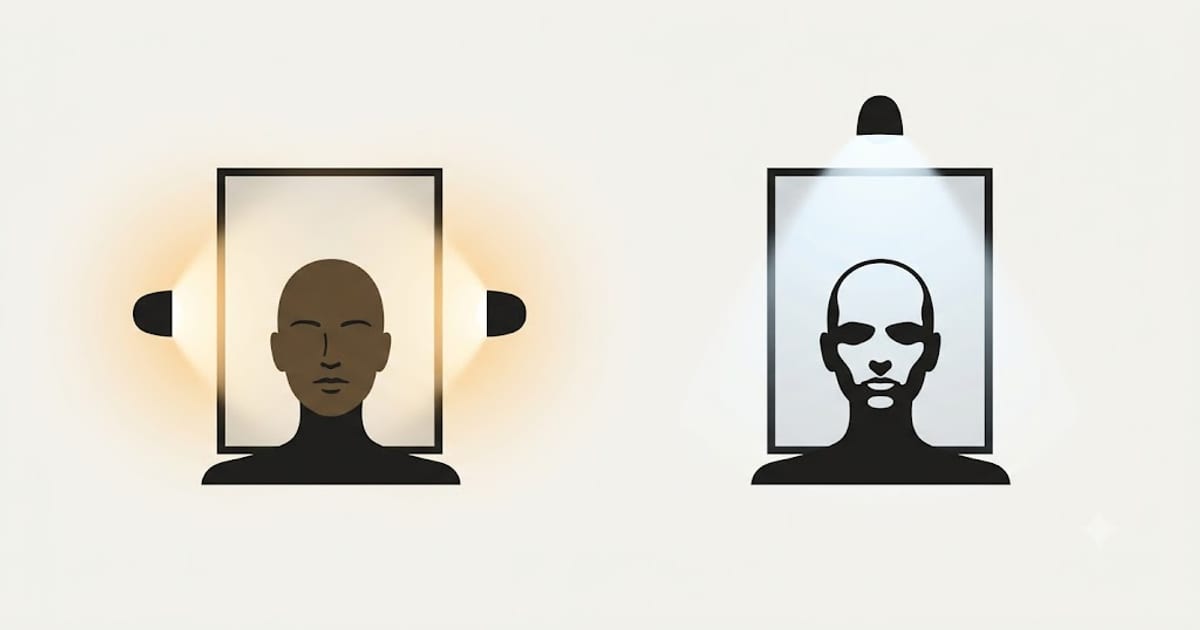
A bathroom has two lighting jobs, and only one of them is about the room. The vanity is a face lighting problem, and it is decided far more by where the fitting sits than by how many lumens it emits.
The general method is in how many lumens a room needs.
The numbers
General bathroom light: 20–30 lumens per square foot.
Vanity: 50–80 lumens per square foot over the vanity area, or in practical terms 1,600–2,400 lumens at the mirror for a normal single vanity.
| Bathroom | General | Vanity |
|---|---|---|
| 40 sq ft | 800–1,200 lm | 1,600–2,400 lm |
| 60 sq ft | 1,200–1,800 lm | 1,600–2,400 lm |
| 100 sq ft | 2,000–3,000 lm | 1,600–2,400 lm (single) |
Note that the vanity figure barely changes with room size — it depends on the mirror, not the floor.
Position is the whole problem
A light above the mirror shines down on your face. Everything that projects — brow, nose, chin — casts a shadow on what is beneath it. Making that fitting brighter deepens the shadows.
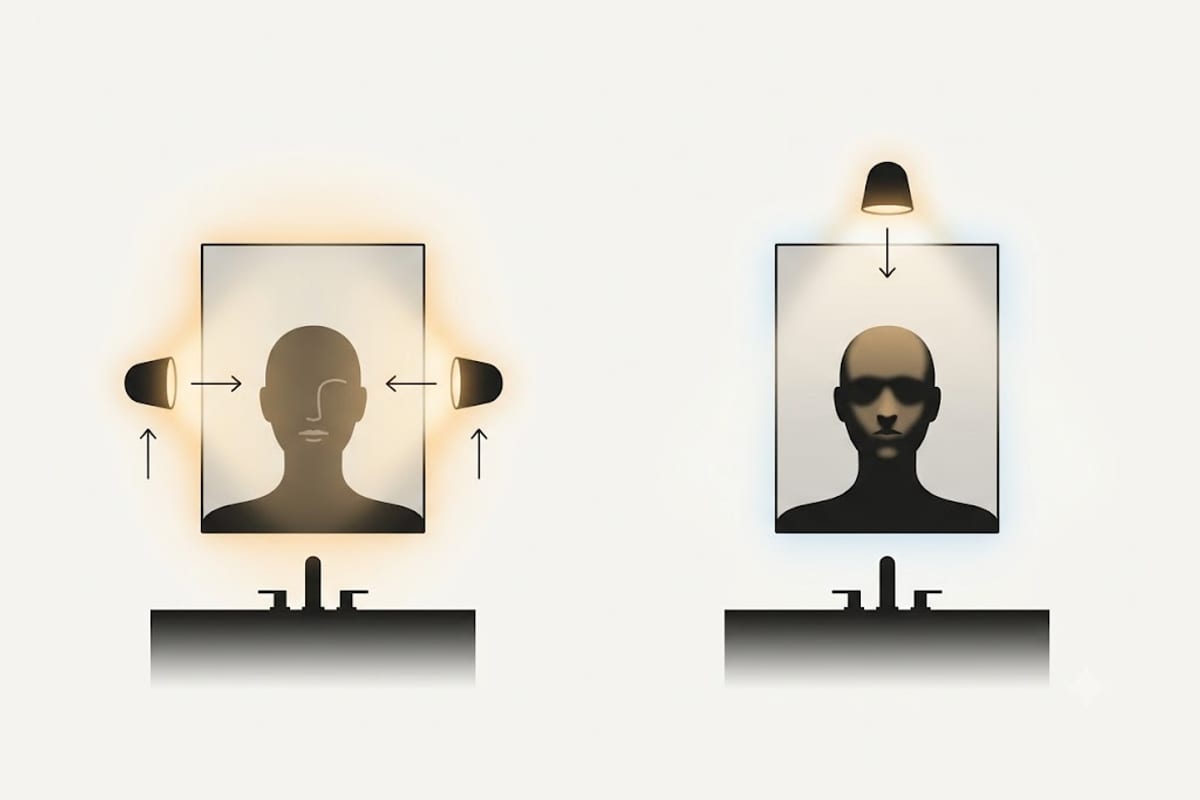
Light from both sides at roughly face height fills those shadows from the left and the right, which is why it is the standard for makeup mirrors and theatre dressing rooms and has been for a century.
In order of preference:
- Sconces or vertical fittings on both sides of the mirror, centred at roughly 60–66 inches from the floor, spaced so they sit just outside the mirror edges. This is the correct answer.
- A backlit or edge-lit mirror, which achieves something similar by wrapping light around the perimeter.
- A long horizontal fitting above the mirror, which is better than a small one but still lights from above.
- A single downlight in the ceiling in front of the mirror, which is the worst common arrangement and unfortunately the most frequently installed.
If the wall genuinely will not take side fittings, a wide diffused fitting above the mirror plus a bright general layer is the compromise — the room bounce fills some of the shadow.
Colour rendering matters here more than anywhere
CRI — colour rendering index — measures how accurately a light source shows colours against a reference. It is a separate property from colour temperature.
In a bathroom, low CRI shows up as skin tones that look wrong and makeup that is applied to look correct under the bathroom light and then looks wrong in daylight.
Look for CRI 90 or above at the vanity, and pay attention to R9 if the manufacturer publishes it. R9 is the deep red component, it is not included in the headline CRI average, and it is the one that governs whether skin looks healthy or grey. A lamp can advertise CRI 90 with poor R9 and still render faces badly.
Colour temperature
3000 K to 3500 K is the usual recommendation for a vanity. Warm enough not to feel clinical, neutral enough that colours read close to daylight.
- 2700 K is pleasant for the room and slightly too warm for grooming — it flatters, which is exactly the problem if you are applying makeup you intend to wear outside.
- 4000 K and above reads accurately but feels cold, and in a small tiled room it can be genuinely unpleasant.
Match the two layers. General and vanity lighting at different temperatures looks wrong immediately, and a bathroom is small enough that you see both at once.
The other layers
General. A ceiling fitting at the room's target lumens. In a small bathroom this and the vanity between them are the whole installation.
Shower. A wet-rated recessed fitting if the shower is enclosed or separated enough that the general light does not reach it. This must be rated for the location — that is a code requirement, not a preference, and it varies by how close the fitting is to water.
Night. A bathroom is the room most often used in the middle of the night. A very low-level option — a dimmed circuit, a low nightlight, or a lit mirror at its lowest setting — is worth more than most of the rest of the specification.
What this page does not cover
- Electrical safety and zone requirements around baths and showers are code-governed, vary by jurisdiction, and are a job for a qualified electrician.
- Extraction and ventilation, which often shares a circuit with the lighting and has its own requirements.
- The general method and the room corrections are in how many lumens a room needs.
- Mirror and fitting sizing as a proportion of the vanity, which is an aesthetic question rather than a lighting one.
Two fittings either side of the mirror at face height, CRI 90 or better, 3000 K. The lumens are the easy part.
Placing side fittings, to the inch
"Sconces on both sides" is the right answer and it needs four numbers to execute.
Height: 60–66 inches to the centre of the fitting, measured from the finished floor. That puts the light source at roughly eye level for an adult standing at the basin, which is the whole point — light arriving horizontally fills the shadows that overhead light creates.
Spacing: 28–40 inches apart, centre to centre. Closer than 28 and the two sources start behaving like one; wider than 40 and the light comes from too far to the side, producing a different shadow rather than filling the existing one.
Offset from the mirror: as close as the mirror allows. The fittings should sit just outside the mirror edges, typically 2–4 inches clear. Set further out and the light rakes across the face from the side.
Projection from the wall: under 5 inches where the mirror is over a basin someone leans toward. Fittings that stick out further are hit by elbows.
When the mirror is too wide, which is the common failure with a double vanity or a mirror spanning the whole wall, side fittings placed at the mirror edges are 60 inches apart and do nothing useful. Three options: a vertical fitting mounted on the mirror face at each side of each basin position; a backlit mirror, which handles any width; or accept a long horizontal fitting above and add a bright general layer to bounce fill light back.
A bathroom is a box of mirrors
Every other room has surfaces that scatter light. A bathroom has tile, glass, glazed ceramic, chrome and a mirror — surfaces that reflect it specularly, at an angle, in one direction.
Three consequences that change the specification.
A bathroom needs fewer lumens than the table suggests. All that reflectance recycles light efficiently — this is the room where the pale-surface correction of 0.85 is most justified, and gloss tile pushes it further.
Bare lamps are much worse here than elsewhere. An exposed filament or LED chip appears as a hard bright point in every reflective surface at once — in the mirror, in the tile, in the shower screen, in the tap. The same fitting in a carpeted bedroom would be unremarkable. Diffused fittings and frosted glass are close to mandatory.
Watch the mirror geometry. A ceiling downlight positioned in front of the mirror puts a bright reflected disc in it at roughly eye height for anyone standing at the basin. It is easy to avoid at the layout stage and impossible to fix afterwards.
Matt tile makes all three problems smaller. Where gloss is already fitted, the answer is diffusion at every fitting rather than lower output.
Magnifying mirrors are a separate fitting
A shaving or makeup mirror is not the vanity mirror at higher magnification — it is a different lighting problem, because the face is much closer to the mirror and therefore blocking much more of the room light.
At 5× or 10× magnification with the face 6–8 inches from the glass, a well-lit vanity delivers almost nothing to the area being looked at. This is why lit magnifying mirrors exist and why they are worth having even in a bathroom that is otherwise correctly lit.
Specification for one: CRI 90+ and the same colour temperature as the vanity fitting, because switching between the two while applying makeup with different colour temperatures produces exactly the mismatch the vanity specification was trying to avoid. Output of 300–600 lumens is plenty at that range.
The night setting, specified properly
A bathroom is the room most often entered in the dark, and getting this right is worth more day to day than any other part of the specification.
One to five lumens is enough to move safely in a small room with reflective surfaces. That is roughly a hundredth of the general fitting.
Amber, 1800–2200K, for the reasons that apply to any night-time light: it carries almost none of the wavelengths that wake the body clock.
Low and indirect. Under the vanity unit, behind the toe kick, or a plug-in unit at skirting level. Light from below is far less disruptive than a ceiling source, and it lights the floor, which is what you need to see.
Motion-triggered. Nobody finds a switch at 3 am, and nobody turns it off.
The alternative that is almost as good and costs nothing extra: put the general light on a dimmer and leave it set low. The limitation is that somebody will turn it up and not turn it back down, which is why a separate dedicated source usually wins.