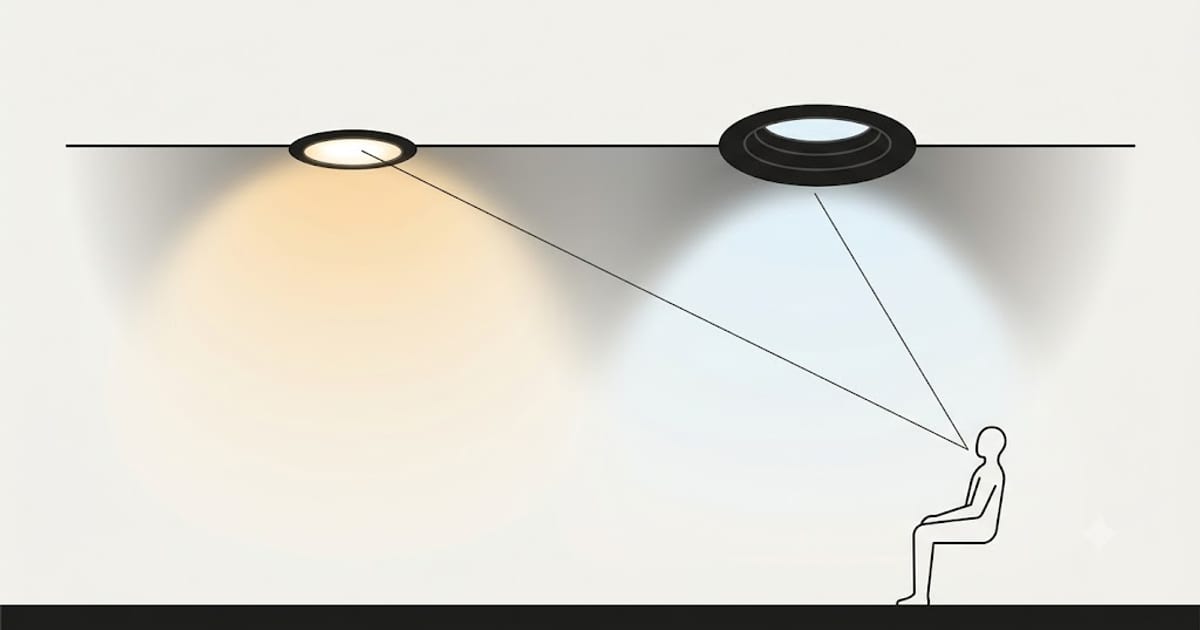
A ceiling can be correctly spaced, correctly specified for lumens, and still be unpleasant to sit under. The lighting is not too bright. The sources are.
The problem is luminance, not illuminance
Two different quantities get confused here, and separating them explains everything else.
Illuminance is how much light lands on a surface — footcandles or lux. It is what the room calculation gives you and what a meter on your desk reads.
Luminance is how bright a source appears when you look at it. It is light per unit of area, and a small emitter concentrating the same output into less area has far higher luminance.
An old 60 W frosted incandescent spread its output over a large glass envelope. A modern LED emitter is a chip a few millimetres across behind a small lens. The same lumens from a fraction of the area is many times the luminance, and that is what the eye objects to.
So a room can be perfectly lit by every measure of illuminance and still feel harsh, because half a dozen very small very bright objects are sitting in the ceiling.
Recess depth is what separates comfortable from not
The single most useful specification is how far the emitter sits above the ceiling plane.
A shallow fitting puts the bright source close to the ceiling surface, where it is visible from anywhere in the room including a seated position across it. A deeply recessed fitting hides the source behind the walls of the housing until you are almost directly underneath.
The angle at which a source disappears is the cut-off angle. A fitting with a deep baffle and a 40° cut-off is invisible to anyone more than a couple of metres away at seated eye height; a flush one is visible from everywhere.
| Feature | Effect |
|---|---|
| Deep recess, 25 mm+ above the plane | Source hidden from normal sight lines |
| Dark or black internal baffle | Absorbs stray light, kills the bright ring |
| Honeycomb or louvre insert | Very high cut-off, small light loss |
| Frosted or opal diffuser | Spreads the emitter over more area |
| Flush white bezel, shallow | Highest glare — the common cheap fitting |
The unhelpful part is that the fitting that causes the problem is usually the one chosen for looking tidy: a slim flush bezel sitting almost level with the plaster.
UGR, and what number to look for
There is a published measure. Unified Glare Rating condenses source luminance, background brightness, size and position into one figure, and lower is better.
As a rough guide, UGR under 19 is the usual target for an office or a room where people sit; under 16 is noticeably comfortable; over 22 is where complaints start.
Domestic fittings rarely publish it — it appears mostly on commercial specifications. Where it is absent, recess depth and baffle colour are good proxies, and anti-glare or deep baffle in a product name usually means the manufacturer has done something about it.
Six fixes, cheapest first
1. Change the lamp, not the fitting. In a GU10 housing, a lamp with a frosted rather than clear lens spreads the emitter over more area and reduces luminance directly. Costs the price of a bulb and often solves it.
2. Fit black baffle inserts. Many housings accept a replacement bezel with a deep dark baffle. Much less visible source, small light loss, no cutting.
3. Dim it. Luminance falls with output. A grid that is uncomfortable at full is often fine at 60%, and the room total was probably designed for daytime anyway.
4. Aim them away. Where the fittings are gimbal type, tilting them off vertical toward a wall converts direct glare into a wash, and lights the vertical surface that makes the room read as bright.
5. Add light at eye level and use fewer downlights. Two lamps and a downlight grid at half output is a more comfortable room than the grid alone at full, at the same total lumens. This is the fix that improves the room rather than just removing a complaint.
6. Replace with deep-recessed fittings. The proper answer where the ceiling is being redone anyway, and the one to specify from the start.
Where it matters most
Glare is a function of where people look, so the same fitting is a problem in one room and not in another.
Worst: any room where people recline or look up. A bedroom with downlights over the bed is the clearest case — you spend time lying down looking straight at the ceiling. A living room with a sofa facing across the room comes second, because the fittings on the far side of the ceiling sit in the sight line.
Bad: dining tables. People sit still for a long time facing each other, and the fittings behind each person's head are directly in the other's view.
Fine: kitchens, hallways, bathrooms, utility. You are standing, moving, and looking downward at what you are doing.
That distribution gives a useful design rule. Use downlights freely in rooms you move through, sparingly in rooms you sit in, and not at all directly over a bed. The general layout arithmetic is in recessed light spacing, and the argument for keeping downlights as one layer rather than the whole scheme is in how many recessed lights in a 12×12 room.