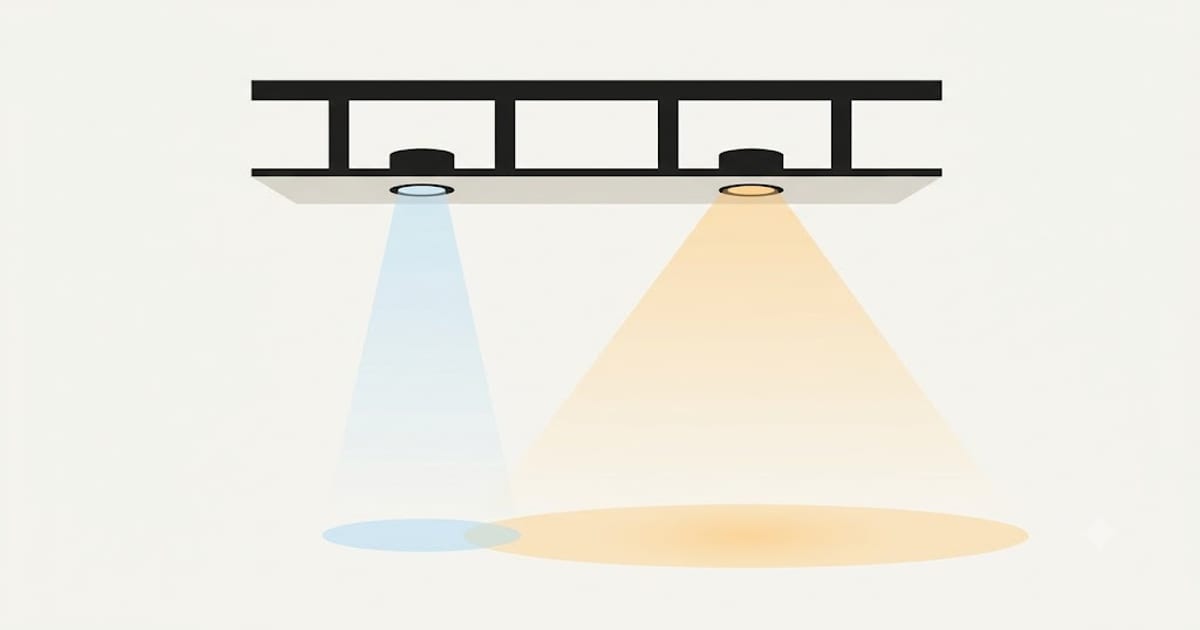
A halogen-to-LED swap looks like the simplest job in a house: the lamp fits the same holder and the ceiling looks unchanged. Four things change underneath it, and each one has its own way of going wrong.
1. Beam angle, and why the room looks different
This is the change people notice and cannot explain.
A 50 W halogen GU10 had a beam angle of roughly 36–38°, near-universally. It was a property of the reflector and it barely varied between brands.
LED replacements range from 25° to 120°. Fit a 120° lamp where a 38° one used to be and the pools merge, the walls get more light, the floor gets less concentrated light, and the whole ceiling reads flatter. Fit a 25° lamp and you get hard-edged spots with dark gaps.
Neither is wrong. But the spacing in your ceiling was chosen for 38°, and changing the beam changes whether that spacing still works.
Match the beam angle to what came out unless you are deliberately changing the effect. For a general ceiling grid on a standard 8 ft ceiling, 36–60° is the usable range; the full relationship between beam angle and spacing is in recessed light spacing.
2. The dimmer almost certainly needs changing
A halogen lamp is a resistive load with thermal inertia — the friendliest thing a dimmer can be asked to control. An LED is an electronic load with a driver that responds instantly.
Two problems arrive together.
The dimmer is the wrong type. Halogen installations use leading-edge dimmers, which chop the start of each mains cycle and produce a sharp switching edge. LEDs want trailing-edge. The symptoms of the mismatch are buzzing, flicker, and a lamp that jumps to full at the bottom of the dial. See trailing edge vs leading edge.
The load collapses below the dimmer's minimum. Six 50 W halogens is 300 W. Six 5 W LEDs is 30 W. Older dimmers commonly specify a minimum of 40 W or more, so a circuit that was comfortably in range is now under it — and below the minimum a dimmer cannot regulate. The arithmetic is in minimum load for an LED dimmer.
Replacing the dimmer with a modern LED-rated trailing-edge unit fixes both at once, and it is a like-for-like swap in the same backbox.
3. If they are MR16, there is a transformer
Look at the base of the lamp you removed. Two thick pins with disc ends that twist to lock is GU10, running on mains, and there is no transformer to worry about.
Two thin straight pins that pull out is MR16, running on 12 V, and there is a transformer above the ceiling for every fitting or group of fittings.
That transformer was sized for halogen and has a minimum load of its own — often 20 W or more on the electronic type. Three 5 W LED lamps total 15 W, below it, and the result is flicker or lamps that will not start.
Three ways forward: replace the transformer with an LED driver rated from a low minimum; convert the fittings to GU10, which removes a component that can fail; or add load, which works and wastes the saving. The full comparison is in GU10 or MR16.
4. The fire rating belongs to the fitting, not the lamp
Cutting holes in a ceiling reduces the fire resistance that ceiling provides between floors, and fire-rated downlights contain an intumescent material that closes the hole in a fire.
Changing the lamp does not change the rating — that is a property of the housing. So a halogen-to-LED lamp swap leaves the fire rating exactly as it was, for better or worse.
Two situations where it matters:
If the existing fittings are not fire-rated and the ceiling separates floors, the lamp swap is a good moment to change the whole fitting rather than just the lamp.
If you are replacing whole fittings anyway, check three ratings together: fire-rated where the ceiling separates floors, IC-rated if insulation will contact the housing, and airtight if the ceiling is the top floor — because a dozen non-airtight downlights move a surprising amount of warm air into a loft.
The one thing that gets better without any effort
Heat. A 50 W halogen in a ceiling void ran hot enough to be a genuine problem: it needed clearance from insulation, it cooked the fitting, and six of them heated the room measurably in summer.
A 5 W LED does not. That removes the insulation-clearance headache that made halogen downlights such a poor fit for an insulated ceiling, and it is the reason a modern LED downlight can be IC-rated and sealed where a halogen one could not.
Integrated fittings: the decision worth making now
If the fittings are being replaced rather than just relamped, there is a choice that decides what happens in five years.
Integrated LED fittings have the LED bonded to the housing. Slimmer, often cheaper, better thermally, and available in very shallow depths for tight joist voids. When it fails, the whole fitting is replaced — which means cutting, sometimes to a different hole size.
GU10 fittings take a standard lamp. The fitting outlives several lamps, a failure costs the price of a bulb, and you can raise the CRI or change the colour temperature later without touching the ceiling.
For a ceiling you expect to keep, GU10 is the more forgiving choice. Buy two spare fittings either way — model ranges turn over quickly, and a single replacement three years later rarely matches the row it sits in.