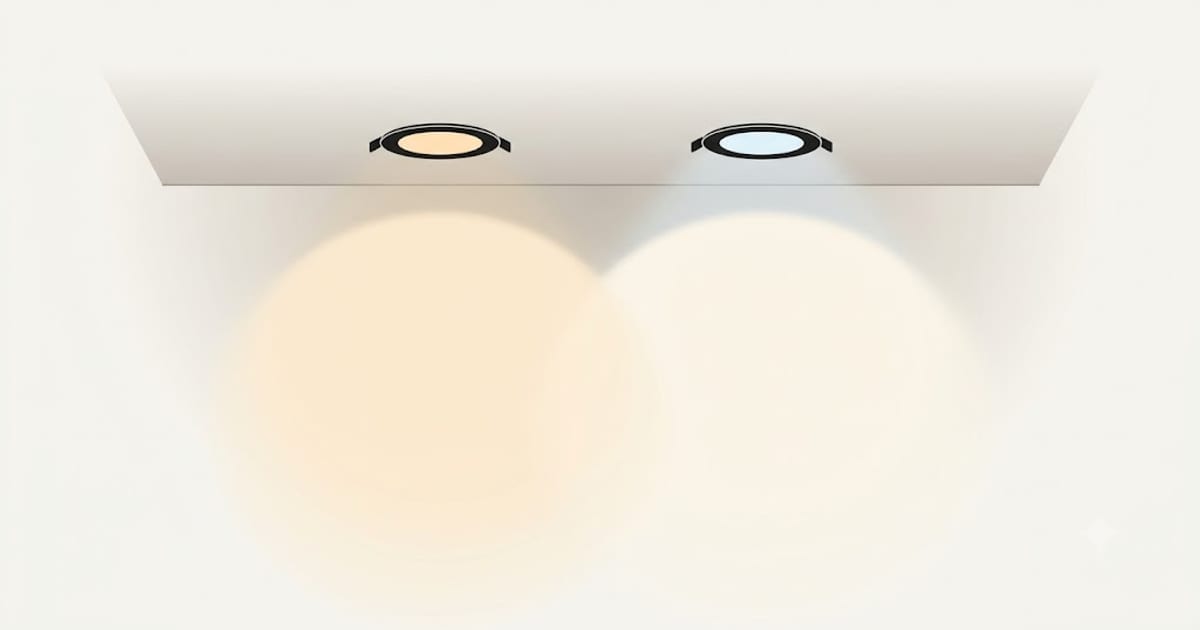
These two are 300 kelvin apart, both sold as "warm white", and they behave very differently depending on whether you can see them at the same time.
Alone, in a room, on a normal evening — most people cannot reliably tell them apart. The eye adapts to whatever white is in front of it and calls it white. Within a minute of walking in, 2700K and 3000K both simply read as "warm light".
Side by side, they are obvious to everyone. Put a 2700K downlight next to a 3000K one and the difference is immediate. One looks slightly yellow, the other slightly grey — and because there is no reason for two ceiling lights to differ, it reads as a fault rather than a choice.
That contrast between the two situations is the whole practical story.
What each one actually is
2700K is the colour of a traditional incandescent bulb. When people say they want light that feels like a home rather than an office, this is the number they are describing. It is the default for living rooms, bedrooms and anywhere the light is on in the evening.
3000K is a small step cleaner. Whites look whiter, blues stop going muddy, and detail resolves slightly better. It is the default for kitchens with warm finishes, bathrooms, hallways and stairs.
| 2700K | 3000K | |
|---|---|---|
| Reads as | Lamplight, candle-adjacent | Warm but clean |
| Best in | Living room, bedroom, dining | Kitchen, bathroom, hall, stairs |
| Wood and cream | Rich, saturated | Slightly cooler, still good |
| White and grey | Faintly yellow | Clean |
| At low brightness | Excellent | Good |
| For close work | Poor | Acceptable |
How to choose, in one question
Is the room mostly for being in, or mostly for doing something in?
Being in — sitting, eating, talking, watching, sleeping — takes 2700K. Doing something in — cooking, washing, working, moving through — takes 3000K.
If a room does both, decide by which activity happens in the evening, because that is when artificial light does most of its work. A dining room that occasionally hosts a laptop is still a 2700K room.
The mixing problem is the real risk
Because the two are so close, people buy them casually — a 3000K replacement for a failed bulb in a 2700K room, a pack of each from different shops — and end up with both in one ceiling.
The eye is very good at adapting to one white point and very bad at adapting to two. Faced with a mixture, it locks onto one and renders the other as tinted. The result is a room where one light looks slightly broken and nobody can say why.
Rules that avoid it:
- Keep every fitting in a single sightline at one colour temperature. An open-plan kitchen-diner is one sightline, even though it is two rooms.
- Buy all the bulbs for a room at once, ideally the same batch. This also protects against manufacturing spread.
- Note the colour temperature somewhere you will find it in three years — inside the consumer unit door works — because you will not remember when one fails.
Task lighting is the deliberate exception. A cooler under-cabinet strip is acceptable because you never see the source, only the worktop it lights. That arrangement is covered in 3000K or 4000K in a kitchen.
Bulbs labelled the same are not always the same
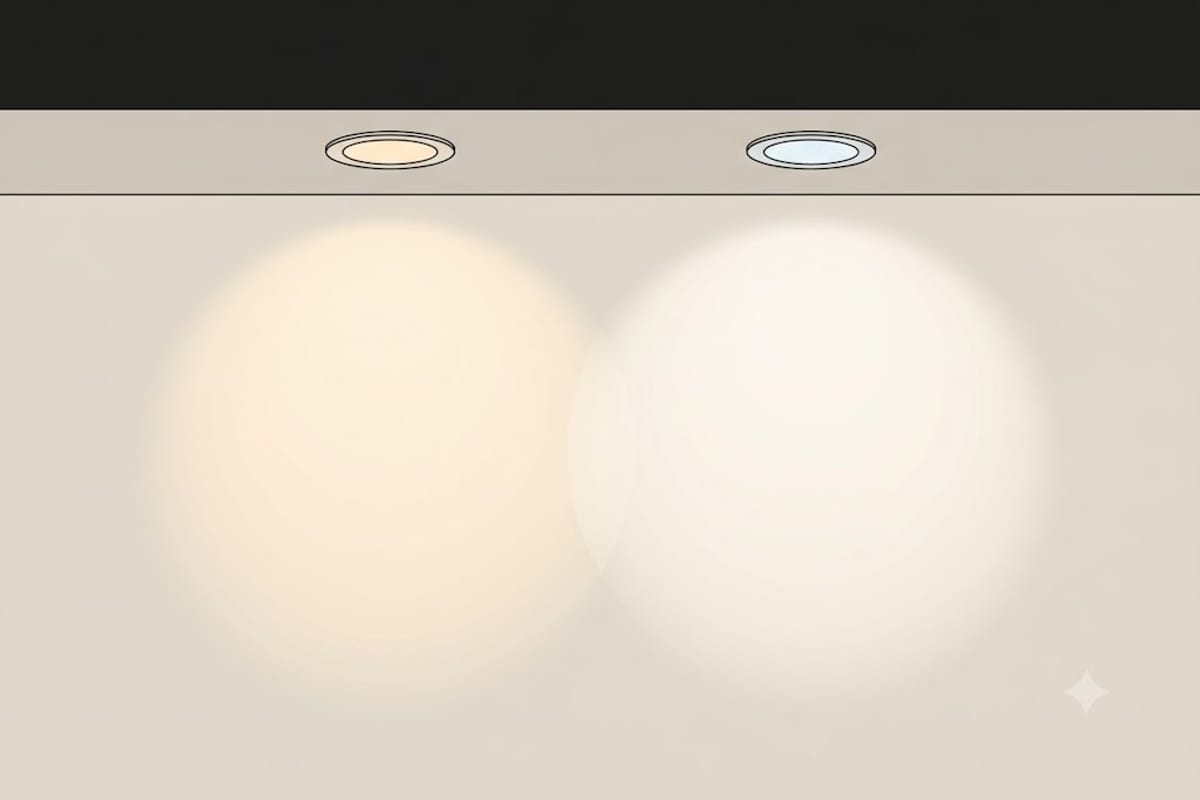
Two bulbs both marked 3000K can be visibly different, and this catches people who did everything else right.
The specification that controls it is SDCM, sometimes given as MacAdam steps. It measures how tightly a manufacturer holds the colour point:
- 3-step or lower — differences are not visible to most people. This is what you want.
- 5-step — visible when fittings are side by side.
- Unspecified — assume the worst; it is unspecified for a reason.
Bulbs sold on colour temperature alone, with no SDCM figure and no CRI figure, are competing on price. In a ceiling with six downlights, that is where the mismatched one comes from.
Getting the rest right
Colour temperature only decides how the light looks. How much of it you need is a separate calculation covered in lumens per square foot by room, and how honestly colours appear under it is colour rendering — a specification that changes a room far more than 300 kelvin ever will.
Matching a bulb to a room you did not specify
The common version of this problem: one bulb in a room of six has failed, and nothing was written down. Four ways to work out what the others are, in order of reliability.
Read the collar of a working bulb. Take one out. The colour temperature is printed on the collar or the base on nearly every LED bulb, in small type. This is the answer, and it takes two minutes.
Look up the fitting. Integrated LED downlights often have the figure on a label on the housing above the ceiling, or in the manufacturer's datasheet by model number.
Compare against a known bulb. Buy one 2700K and one 3000K. Fit the 2700K next to an existing one and look; then swap it for the 3000K. Whichever disappears into the row is the match. Keep the other for the next room.
Photograph it. Where two fittings are far apart, a single photo containing both, taken with the camera's white balance locked rather than automatic, will show the difference plainly. Automatic white balance actively removes the information you are trying to see.
What does not work is remembering. The two are close enough that recollection across a few years is worthless, and there is no shame in the two-minute version.
Bulbs drift with age, and it usually goes cooler
A row of downlights installed together does not stay matched forever.
Phosphors degrade unevenly over a bulb's life, and the red-emitting component generally fades faster than the rest. The practical effect is that an ageing warm-white bulb drifts slightly cooler and less warm-toned as it goes.
The drift is far too slow to notice while it happens, because vision adapts continuously. It becomes obvious in exactly one moment: when one bulb in a row of six fails and the new one goes in. The replacement is not wrong — the other five have moved.
Two practical consequences.
Judge a replacement against the neighbours, not against the box. If a correct-on-paper 2700K bulb looks obviously warmer than the row, the row has drifted, and matching the row may mean going to 3000K.
Consider replacing a row as a set where the match matters and the fittings are old. Six bulbs is not expensive, and it resets the whole row to one point.
Regional defaults, and why the shelf is confusing
The two temperatures are not evenly distributed across markets, and the reason is what each region was replacing.
In the United States, the incandescent bulb was the reference for a century, and it runs at about 2700K. American retail defaults to 2700K as "soft white", and 3000K is sold as a slightly brighter-feeling alternative.
In much of Europe, halogen was a longer and more visible transition technology, and halogen runs closer to 3000K. Many European ranges default to 3000K as "warm white", with 2700K sold as "extra warm".
So the same physical bulb can be the standard option in one market and the speciality option in another, and the marketing names do not map cleanly across the boundary. Ignore the name and read the kelvin figure, which is the one thing that means the same everywhere.
When 2700K starts to feel too warm
A room can be correctly specified at 2700K and still feel wrong, and there is a predictable reason for it.
Warm light amplifies whatever warmth a surface already has. A room redecorated from cream and oak to white and grey has lost the surfaces the light was flattering, and 2700K on cool grey reads as dingy rather than cosy — the grey picks up a brownish cast.
The fix is usually 3000K rather than 4000K: enough to clean up the greys without turning an evening room into a workspace. This is the single most common reason to change a room's colour temperature after the fact, and it is worth checking before concluding the new decoration was a mistake.