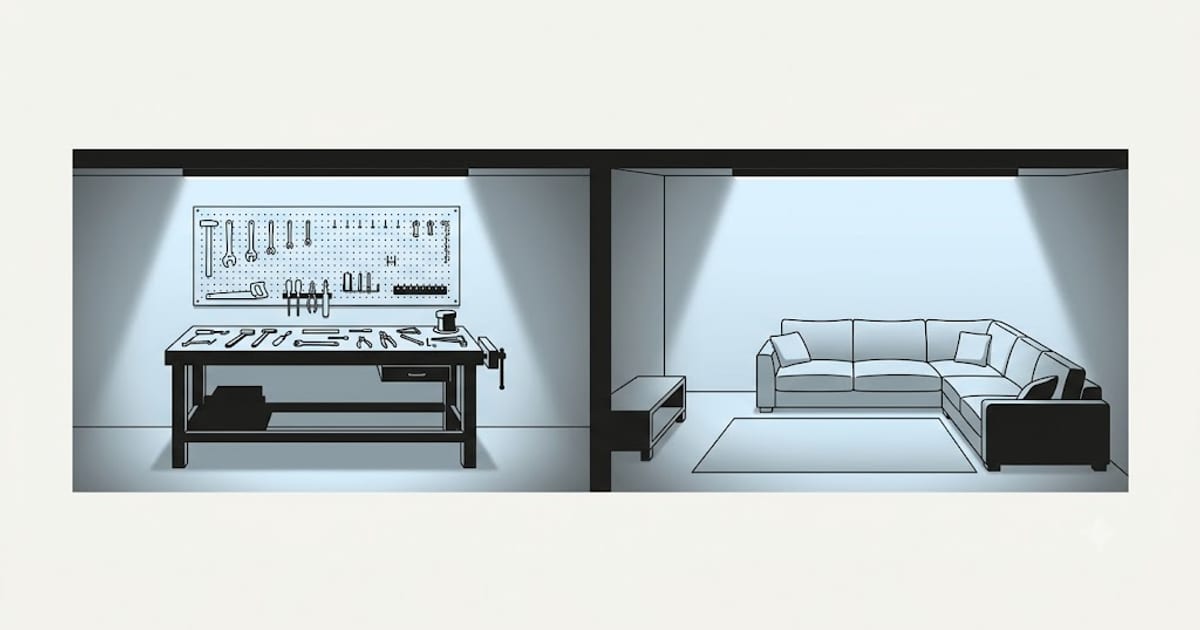
5000K bulbs are usually sold as "daylight", which is accurate, and bought because someone wanted more light, which is a misunderstanding. A 5000K bulb is not brighter than a 2700K bulb. Brightness is lumens. Colour temperature is colour. A 800-lumen bulb puts out 800 lumens at any kelvin.
What 5000K does do is make things look crisper — and there is a reason for that which tells you exactly where it belongs.
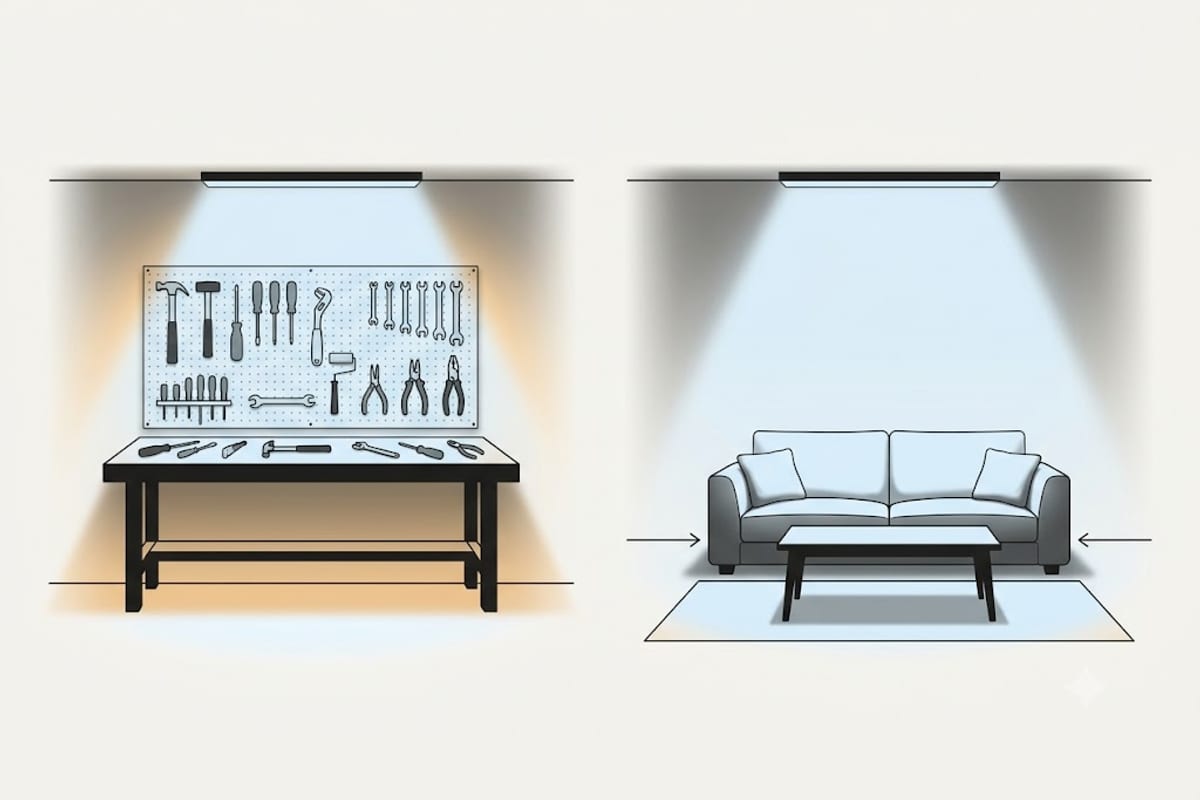
The test: are you looking at something, or looking around?
Cooler light improves the perception of fine detail and edges. It also flattens warmth out of everything it touches, including skin, wood and fabric.
So the question is not what room you are in. It is what you are doing with your eyes.
Inspecting — reading a serial number, matching a colour, finding a dropped screw, checking whether a stain has come out — benefits from 5000K.
Occupying — sitting, eating, talking, relaxing — is made worse by it.
Where 5000K is the right answer
Garage and workshop. You are identifying small parts, reading fine markings and judging surface finish. Cool light also stays comfortable at the high light levels these spaces need — around 50 foot-candles, far above a living room.
Laundry room. Assessing whether a stain has actually gone requires seeing the colour honestly, and warm light hides exactly the yellowish marks you are checking for.
Closets and dressing areas. Navy against black, charcoal against brown — warm light collapses those distinctions. This is the single highest-value 5000K fitting in most houses, and it costs the price of one bulb.
Basement and utility spaces without windows. These read as gloomy at any brightness. Cool light offsets that, and there is nothing in them whose warmth you are trying to preserve.
Task lighting inside a warmer room. An under-cabinet strip or a desk lamp can run cooler than the room around it, because you never look at the source — only at what it lights.
| Space | Kelvin | Why |
|---|---|---|
| Garage, workshop | 4000–5000K | Detail work at high light levels |
| Laundry | 4000–5000K | Honest colour on fabric |
| Closet interior | 4000K | Separating dark colours |
| Basement, utility | 4000–5000K | Offsets a windowless space |
| Desk or under-cabinet task | 4000K | Source is never in view |
The four rooms it ruins
Living room. Every soft surface in it — fabric, wood, rugs, skin — depends on warmth to look right. 5000K in the evening is the single most common lighting mistake in a house.
Bedroom. Beyond looking wrong, it works against you. Blue-rich light in the evening suppresses melatonin and delays sleep, which is covered in bedroom colour temperature.
Dining room. Food photographs and food appetite both depend on warm light. Cool light makes cooked meat look grey and vegetables look tired. Restaurants have known this for a century.
Bathroom, at the mirror. This one surprises people, because a bathroom is a task space. But you are looking at a face, and 5000K over a mirror is unflattering in a way that has nothing to do with the mirror. 3000K with high colour rendering is what the vanity lighting rule calls for.
Why 5000K gets bought by accident
Three reasons, all of them avoidable:
- "Daylight" sounds like a benefit. It is a description of the colour, not a claim about quantity.
- Shops are lit at 4000–5000K. Under that light, a 5000K bulb looks normal and a 2700K bulb looks yellow and faulty. The comparison is rigged by the room you are standing in.
- Cool light seems brighter. At the same lumens it is not, but it does resolve detail better, and the brain reads that as brightness.
If a room feels dim, the answer is more lumens, not colder ones. Work out the actual requirement from lumens per square foot by room, or get the number for your own room from the room lighting calculator.
One more thing worth knowing
Above about 5000K, colour rendering usually gets worse rather than better. Very high colour temperature LEDs achieve the blue-white by leaning on a strong blue peak, which leaves gaps elsewhere in the spectrum — most often in the deep reds.
A 6500K bulb with CRI 80 will show reds badly, which in a workshop means resistor bands and wire colours, and in a laundry means blood and rust marks. If you want cool light that is also honest, look for 5000K at CRI 90 rather than 6500K at any price. That specification is explained in what a good CRI is.
Cold starts, and why garages are the exception that works
An unheated garage or workshop in winter is one of the few places where the technology of the fitting matters as much as its colour temperature.
Fluorescent tubes — the traditional occupant of these spaces — start badly in the cold. Below about 10 °C a standard tube flickers, starts dim, and can take several minutes to reach full output, because the mercury vapour pressure inside is temperature-dependent.
LEDs behave in the opposite direction. An LED is more efficient cold than hot, so a fitting in a cold garage starts instantly, at full output, and produces slightly more light than its rating. This is the strongest practical argument for replacing garage fluorescents, and it has nothing to do with energy.
Two things to check on the specification:
Operating temperature range. Most domestic LED fittings are rated to around −20 °C, which covers any garage. Confirm it rather than assume it, because the limiting component is the driver's electrolytic capacitor, not the LED.
Whether the driver is rated for the same range. Integrated fittings quote one figure. Separate driver arrangements can have a driver rated less generously than the light it powers.
Fittings, not just bulbs
A garage lit by bulbs in porcelain holders is a garage with bright spots and deep shadows, and swapping those bulbs to 5000K does not fix it.
LED battens are the right default. A 4 ft or 5 ft linear fitting spreads light along its length, which suits the long narrow shape of most garages and puts light along both sides of a car rather than on its roof.
Sizing. Aim for around 50 foot-candles on the floor of a working garage — roughly three to four times a living room. For a single garage of about 200 ft², that is somewhere near 10,000 lumens total, which is typically two or three battens rather than one.
Position matters more than in a room. Put the fittings over the sides, where you work, rather than down the centre. A single central row is directly above the car and puts you in your own shadow whenever you lean over anything.
IP rating. IP20 is fine for a dry attached garage. A detached garage, a workshop with a concrete floor that gets washed, or anywhere damp wants IP65.
Glare. A bare LED batten at 5000K is uncomfortable to look at, and in a garage you spend a lot of time looking upward from underneath things. A frosted diffuser costs a few per cent of the output and is worth it.
Fixing a room that is already too cool
A house bought or rented with 5000K bulbs throughout does not need all of them changed, and knowing which ones to do first saves most of the cost.
Change what you look at, in this order: the living room, the bedroom, then the dining area. Those three carry nearly all of the discomfort.
Leave alone: garage, loft, cupboards, utility, outdoor security. They are already correct.
Do not try to fix it with dimming. Dimming a 5000K bulb makes it dimmer, not warmer — the colour stays exactly where it was. A dimmed cool light is worse than an undimmed one, because the Kruithof effect means cool light looks increasingly harsh as the level drops. If the room is already cool and already dim in the evening, that is the least comfortable combination available.
Do not try to fix it with shades or filters. A warm-coloured shade tints the light it passes but does nothing for the direct component, and gel filters in a domestic fitting are a fire risk near a lamp of any real output.
The only fix for colour temperature is different lamps. Fortunately it is the cheapest fix in lighting: a room's worth of bulbs costs less than a single fitting, and the whole change takes an afternoon.