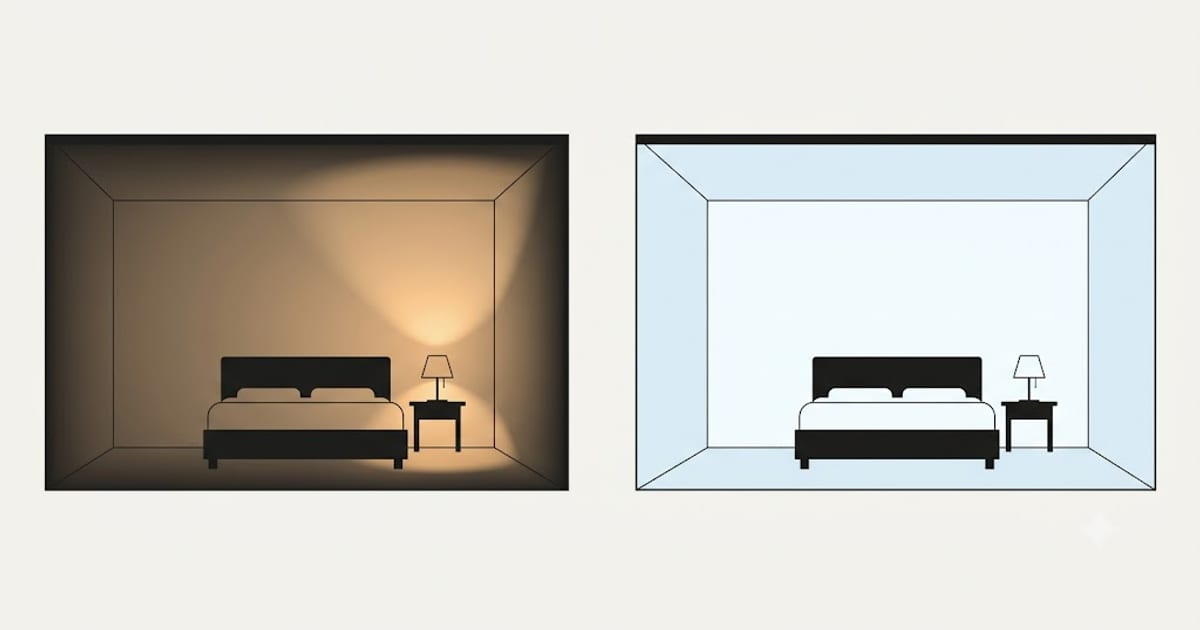
2700K. Of all the rooms in a house, this is the one where the answer is not really a matter of taste — and the reason has nothing to do with how the room looks.
Light in the evening is a signal, not just illumination
The human eye contains photoreceptors that do not contribute to vision at all. They feed the body clock, and they are most sensitive to blue wavelengths — the part of the spectrum that dominates in cool white and daylight bulbs.
Blue-rich light in the evening suppresses melatonin, the hormone that initiates sleep. The effect is dose-dependent: brighter and bluer light delays sleep onset more. This is the same mechanism behind every "night mode" ever shipped on a phone.
A bedroom is used almost entirely in the two hours before sleep. That makes it the one room where the colour of the light has a physiological job, not a decorative one.
| Kelvin | Bedroom verdict |
|---|---|
| 2700K | Correct. Warm, low blue content, matches lamplight |
| 3000K | Acceptable, slightly crisper — reading rooms, dressing areas |
| 4000K | Wrong for the room, right for a closet interior |
| 5000K+ | Actively counterproductive in the evening |
Brightness matters as much as colour
The Kruithof effect describes something you already know without having a name for it: warm light looks natural at low levels and cool light looks natural at high levels. A candle at 1900K is pleasant. A ceiling fitting at 1900K and full brightness would look like a fault.
In a bedroom the practical consequence is that colour temperature and brightness have to move together. A 2700K fitting run at full output in the evening is still too much light, even though the colour is right.
This is why the single most effective bedroom lighting change is not the bulb — it is putting the main light on a dimmer and adding a bedside lamp that can carry the room on its own. The overhead light becomes the one you use to find something in a drawer, not the one you read by.
Where the light comes from matters more than most people think
A ceiling fitting in the middle of a bedroom lights the room from directly above. It is the least flattering direction for a face, it puts light in your eyes when you are lying down, and it makes a small room feel like a corridor.
Bedrooms respond better to low, indirect light: bedside lamps, a floor lamp bouncing off the ceiling, wall lights beside the headboard. Three small sources at 2700K produce a room that feels calm in a way one bright ceiling source never does, at the same total lumens.
The total light a bedroom needs is lower than most rooms — around 15 foot-candles — and the bedroom lighting calculator gives the figure for your own dimensions. Split it across sources rather than concentrating it.
The one exception
Closets and dressing areas want 4000K, even inside a 2700K bedroom.
You are matching colours in there — navy against black, charcoal against brown. Warm light collapses exactly those distinctions, which is how people leave the house in trousers that do not match the jacket. Cool light with high colour rendering separates them.
Because the closet is a different space that you are not sitting in, the colour temperature mismatch is not visible from the bed. The rule about not mixing colour temperatures applies within a sightline — a closet with a door is not one.
What about tunable white?
Tunable bulbs shift from around 2700K to 5000K on a schedule or a command, and in a bedroom this is one of the few places where the feature earns its cost:
- Morning: cooler light helps you wake, the same signal daylight would give
- Evening: warm light, dimmed, no melatonin suppression
The catch is that most tunable bulbs have lower colour rendering than a fixed 2700K bulb at the same price, because achieving a wide colour temperature range means compromising the spectrum at every point in it. If you use the bedroom to get dressed and want colours to be honest, a fixed high-CRI bulb beats a tunable one.
That trade-off is covered in what a good CRI actually is.
The short version
Fit 2700K everywhere you can see from the bed. Put it on a dimmer. Add bedside lamps so the ceiling light is optional. Fit 4000K inside the closet. Do not run anything above 3000K in that room after dark, whatever the fitting looks like in the shop.
Getting up at three in the morning
The lighting decision with the biggest effect on a bedroom is not the main fitting at all. It is what happens when someone gets up in the night.
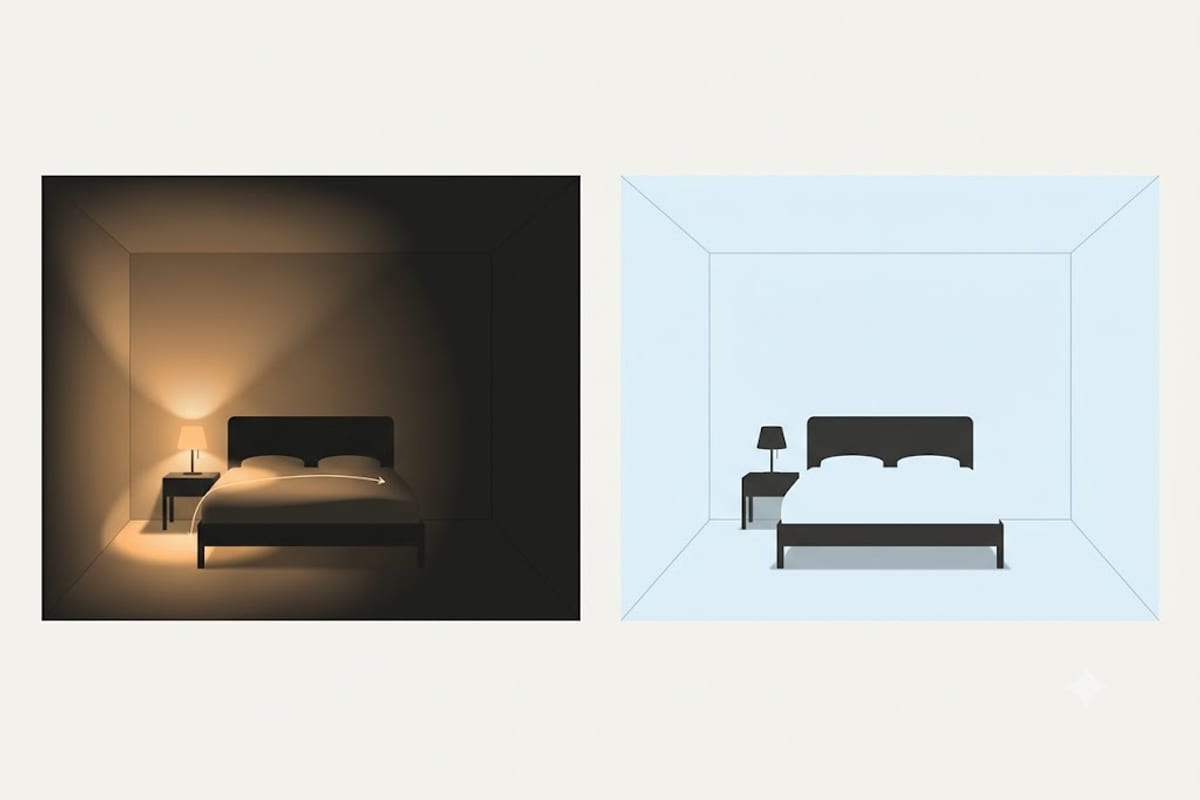
Turning on a 400-lumen bathroom light at 4000K at 3 am does two things: it constricts the pupils so completely that returning to a dark room means feeling your way, and it delivers exactly the wavelengths most effective at telling the body clock that the night is over.
A night-light path solves it, and the specification is unusually strict.
Very low output. Somewhere between 1 and 10 lumens is enough to move safely. That is one or two per cent of a normal fitting.
Amber, not warm white. 1800–2200K. This is the one place in a house where going below 2700K is not decorative but functional — deep amber contains almost none of the wavelengths that suppress melatonin.
Mounted low. At skirting or step height, aimed at the floor. Light entering the eye from below is far less disruptive than light from a ceiling, and a floor-level source lights the thing you need to see.
Motion-triggered, on a short timer. Nobody reaches for a switch at 3 am, and nobody remembers to turn it off.
That combination costs very little and does more for sleep than any bulb choice in the main fitting.
Specifying a reading light properly
The other fitting that earns its place is a bedside reading light, and it fails in predictable ways.
Position beats output. The light should come from behind and slightly above the shoulder, roughly 20–26 inches above the mattress for a seated reader. From there it lands on the page and not in either person's eyes. A lamp on a low table beside the bed lights the wall and the reader's chest.
Narrow beam, or a shade with an opaque side. A reading light that spills across the whole bed makes the other side of it unusable. Adjustable wall-mounted arms handle this best, and swing-arm fittings let one person read while the other sleeps.
200–400 lumens is plenty for reading at close range. More than that and it becomes a second room light.
2700K, and high CRI if you read on paper. Cool light improves fine detail resolution, but a reading light is used immediately before sleep, and that consideration outranks a slight gain in crispness.
On its own switch, within reach of the pillow. The most common reason a carefully specified bedside light goes unused is that turning it off requires sitting up.
Children's rooms
Two differences from an adult bedroom, both worth knowing.
Children's eyes transmit more blue light. A young lens is clearer than an older one, so the same fitting delivers a stronger circadian signal to a child than to an adult in the same room. The argument for warm light in the evening is therefore stronger in a child's room, not weaker.
The room is used as a playroom in the daytime. A single 2700K fitting that suits bedtime is dull for building things on the floor at two in the afternoon.
The arrangement that resolves it is two layers rather than a compromise temperature: a brighter 3000K ceiling fitting on a dimmer for daytime, and a warm bedside or plug-in lamp at 2200–2700K that is the only thing on for the last hour. Trying to serve both with one fitting at 3500K produces a room that is wrong at both ends of the day.
Avoid colour-changing bulbs as the main source. They are enormously popular with children and their colour rendering is generally poor, which matters in a room where homework happens.
Shift work reverses the advice
For someone sleeping during the day and awake at night, the calendar is wrong but the mechanism is the same: bright, cool light on waking; warm, dim light before sleep, whatever the clock says.
That means a shift worker's bedroom often wants the opposite fittings from a normal one — genuine blackout at the window, a bright 4000–5000K source for the first hour awake, and warm amber for the wind-down. Tunable white earns its cost here more clearly than anywhere else in a house, because the schedule genuinely does move.