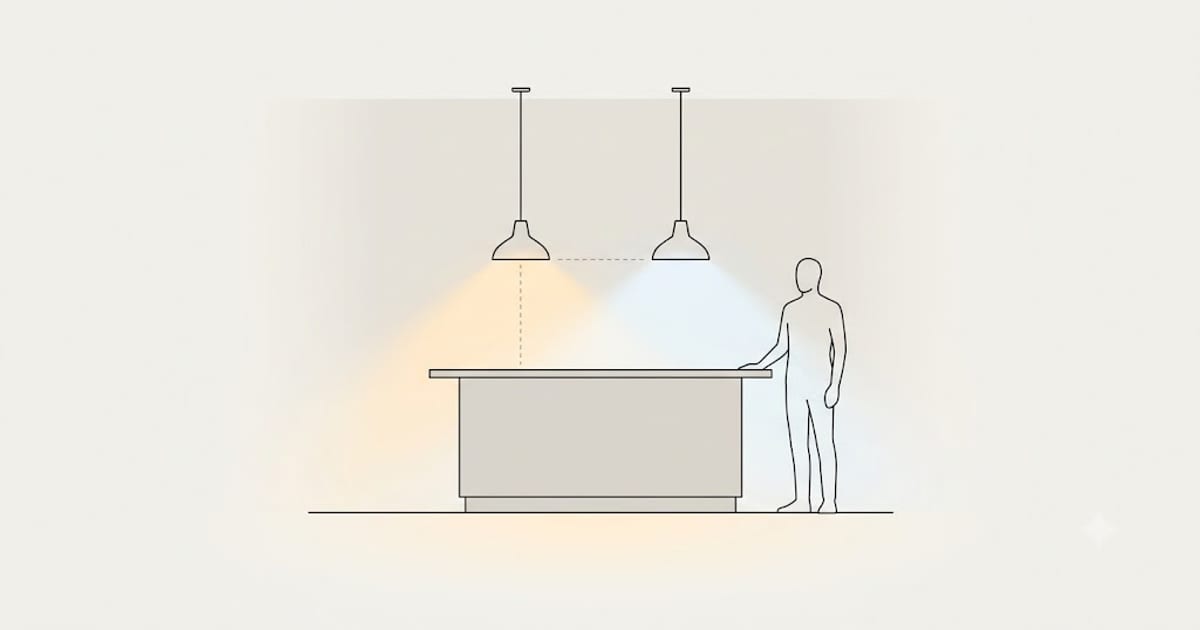
30 to 36 inches from the worktop to the bottom of the pendant. On a standard 36 inch high island with an 8 ft ceiling, that leaves the pendant hanging about 66 to 72 inches from the floor.
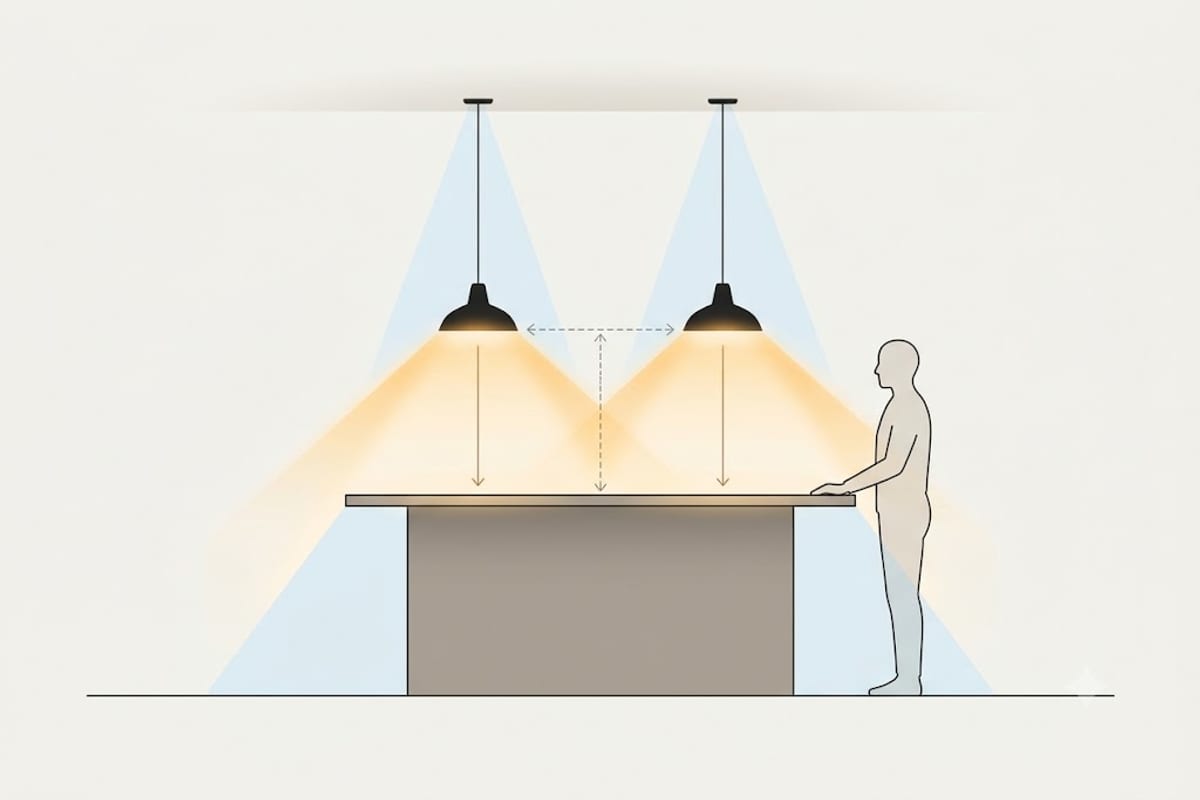
The test that beats the number
Stand at one end of the island and look across it at someone standing at the other end. You should see their face, not a lampshade.
That single check settles most of the ambiguity in the 30–36 inch range. It also explains the range: a tall household wants the top of it, a short one the bottom, and a kitchen where people mostly sit at the island wants pendants higher than a kitchen where people mostly stand and prep.
Go below 30 inches and the pendants are in the sightline and in the way of anything tall on the worktop. Go above 36 and they stop lighting the island and start lighting the room, which is a different job.
How many, and how far apart
Two pendants for an island up to about 7 ft. Three for 7 to 10 ft.
Space them by dividing the island into equal parts, not by putting them a fixed distance apart:
- Two pendants: divide the island length into thirds and hang one at each dividing point. On a 6 ft island that is 2 ft from each end, 2 ft apart.
- Three pendants: divide into quarters. On a 9 ft island that is 27 inches from each end and 27 inches between.
| Island length | Pendants | From each end | Between |
|---|---|---|---|
| 4 ft | 2 | 16 in | 16 in |
| 6 ft | 2 | 24 in | 24 in |
| 7 ft | 3 | 21 in | 21 in |
| 9 ft | 3 | 27 in | 27 in |
| 10 ft | 3 | 30 in | 30 in |
Keep at least 6 inches between the edge of one shade and the next. Pendants that nearly touch look like a mistake, and wide drum shades on a short island often force you down to two.
Adjust for a higher ceiling
The 30–36 inch figure is for an 8 ft ceiling. For every foot of extra ceiling height, add about 3 inches to the drop — so a 10 ft ceiling takes pendants roughly 36–42 inches above the worktop.
The pendant should read as belonging to the island rather than floating between it and the ceiling. On very high ceilings, larger fittings work better than longer cords.
How much light they have to produce
Pendants over an island are task lighting, not decoration, even when they are chosen for how they look.
An island is a work surface, so it wants the kitchen task figure of around 50 foot-candles. A 3 × 6 ft island is 18 ft², which is 18 × 50 = 900 lumens landing on the island.
Split across two pendants that is 450 lumens each — but only if the shade directs light downward. An open-bottomed shade delivers most of its output to the worktop. A fully enclosed globe throws light in every direction and needs roughly double the lumens to put the same amount on the island.
That is the specification error people make most often here: choosing a beautiful enclosed fitting, putting a 450 lumen bulb in it, and discovering the island is dim.
Colour temperature
Match the pendants to the room, not to the under-cabinet lighting. Pendants are in your field of view constantly, so they set the character of the space: 2700–3000K for a kitchen with warm finishes, 3500–4000K for cool ones.
Under-cabinet strips can run cooler because you never see them — the split is explained in under-cabinet lighting lumens.
Do not let them do all the work
An island lit only by pendants leaves the rest of the kitchen dark, and the pendants themselves become uncomfortably bright by contrast because your eye adapts to the dim surroundings.
Pendants are one layer. The general ceiling layer is worked out from how many lumens a kitchen needs, and the fitting layout from recessed light spacing. Put the pendants on their own switch and dimmer so they can be the only thing on in the evening.
How wide the pendants should be
Height is the question people ask. Diameter is the one that decides whether the result looks considered or accidental.
The workable guide: the combined width of the pendants should be somewhere between a third and a half of the island length.
| Island | Two pendants, each | Three pendants, each |
|---|---|---|
| 4 ft | 8–10 in | — |
| 6 ft | 12–15 in | 8–10 in |
| 8 ft | 16–20 in | 11–14 in |
| 10 ft | — | 14–18 in |
Under a third and the pendants read as undersized, like fittings borrowed from a smaller room. Over a half and they dominate, and two of them start competing with each other for the same space.
One physical constraint overrides the aesthetics: keep at least 6 inches between the edges of adjacent shades, and at least 6 inches between the outer shade and the end of the island. A pendant overhanging the island edge is in the way of anyone walking past it.
The shade decides how much light reaches the worktop
Two pendants with the same bulb in them can deliver very different amounts of light to the island, and the difference is entirely the shade.
Open-bottomed cone or dome. Directs nearly all output downward in a controlled pool. Best efficiency onto the worktop, and the bulb is usually recessed enough not to be visible from a seated position.
Enclosed globe or lantern. Emits in all directions, so perhaps a third of the output lands on the island and the rest goes to the ceiling and walls. It lights the room pleasantly and the island poorly. Budget roughly double the lumens for the same effect on the worktop.
Open-top cylinder. Sends a proportion straight up. Good for softening a kitchen with a dark ceiling, wasteful in a room with a high one.
Clear or seeded glass. Beautiful, and it puts the bare filament or LED chip directly in the sightline of anyone sitting at the island. Only use one with a low-output decorative lamp, or with a dimmer you will actually turn down.
Glare is the failure mode nobody plans for
An island pendant hangs at roughly eye height for a seated person. That makes it the fitting in the house most likely to be looked at directly, for the longest stretches.
Three checks before buying:
Sit down and look at the shade at 66–72 inches from the floor. If you can see the lamp itself, so will everyone eating there.
Check the shade's inner surface. A gloss white or mirrored interior throws a hard bright edge; a matt white one diffuses it. On a fitting you look at for an hour every evening, this matters more than the outside finish.
Buy dimmable and wire a dimmer. Island pendants are used at full output for cooking and at a fraction of it for eating, and no single fixed brightness serves both.
An island is not a dining table
The two get treated the same and want different things.
Height. A dining table takes pendants a little higher — typically 32–36 inches above the tabletop — because people sit around all four sides and sightlines cross the table in every direction. An island is usually approached from one side and worked at from the other.
Light level. A dining table is for eating, not for chopping. It wants roughly 20–25 foot-candles against an island's 50, so the same fitting over a table takes a much lower-output lamp — or the same lamp on a dimmer, turned well down.
Colour temperature. A table is an evening space and belongs at 2700K. An island is a work surface for part of its life and tolerates 3000K.
One fitting or several. A round or square table is usually better with a single central pendant or a small cluster; a long island wants a row. Putting a row of three over a round table produces two pendants over nothing.